Carbon monoxide is one of the few home dangers you genuinely cannot see, smell, or taste — and a gas furnace is one of the appliances that can produce it. The good news is that protecting your family is straightforward: understand where it comes from, keep working alarms, and have your furnace checked once a year. Here’s what every homeowner with gas heat should know before winter.
What carbon monoxide is and why it’s so dangerous
Carbon monoxide, or CO, is a gas produced whenever fuel burns — natural gas, propane, wood, gasoline. Any appliance that burns fuel makes a little of it. In a properly working system, that CO is carried safely out of your home through the flue or vent and you never come into contact with it.
What makes CO so dangerous is that it gives you no warning. It’s colorless and odorless, so there’s nothing to alert you the way a gas leak’s added smell would. When you breathe it, CO binds to your blood and crowds out the oxygen your body needs, which is why exposure can make people sick — or worse — before they realize anything is wrong. According to general public-safety guidance from sources like the CDC and fire departments, it’s one of the most common causes of accidental poisoning in the home, and it sends many people to emergency rooms each year, with cases rising in the colder months when heating runs hardest.
None of that is meant to scare you off gas heat — it’s safe and common. It’s meant to explain why the simple precautions below matter so much.
The most common HVAC causes of carbon monoxide
When CO does get into a home from the heating system, it’s almost always one of a handful of fixable problems. These are the ones a technician looks for during an inspection:
A cracked heat exchanger
The heat exchanger is the metal wall inside a gas furnace that separates the burning gas and its exhaust from the clean air blown into your home. If it cracks — usually from years of heating-and-cooling stress — combustion gases including CO can leak into the air stream. This is the single biggest furnace-related concern, and it’s a major reason annual inspections exist.
A blocked or leaking flue or vent
The flue is the path that carries exhaust safely outside. If it’s blocked by a bird’s nest, debris, or corrosion — or if a section has come loose or rusted through — exhaust gases can back up into the home instead of leaving it.
Poor or incomplete combustion
A furnace that isn’t burning cleanly — from a dirty burner, a bad gas-to-air mixture, or a unit out of adjustment — produces more CO than it should. Clean, properly tuned combustion keeps CO output low and where it belongs.
Blocked vents and starved airflow
Fuel-burning appliances need air to burn safely and to vent properly. Blocked combustion-air openings, sealed-up utility closets, or vents covered by leaves and debris can disrupt that balance and push exhaust the wrong way.
Every one of these causes is something a licensed technician checks during a routine inspection of a gas furnace. A seasonal tune-up before winter is the simplest way to catch them early — before they ever become a problem in your home.
Warning signs in your home and in people
Because CO is invisible, the warning signs fall into two groups — clues around the house and symptoms in the people inside it. A reference you can keep handy:
One important note on symptoms: CO poisoning can feel like the flu — headache, dizziness, nausea, weakness, confusion — but without a fever. A telling clue is that everyone in the home feels it at once and starts to feel better after going outside.
Detectors, placement, and prevention
Two habits prevent the overwhelming majority of carbon monoxide problems in a home: working alarms and an annual furnace inspection.
Get CO detectors placed right
General fire-safety guidance is to install a carbon monoxide alarm on every level of the home and outside each sleeping area, so an alarm at night will wake you. Mount them per the manufacturer’s instructions, keep them a sensible distance from fuel-burning appliances to avoid nuisance trips, test them monthly, and replace the unit every five to seven years — check the date printed on yours. Combination smoke-and-CO alarms are fine as long as they’re rated for both.
Inspect the gas furnace once a year
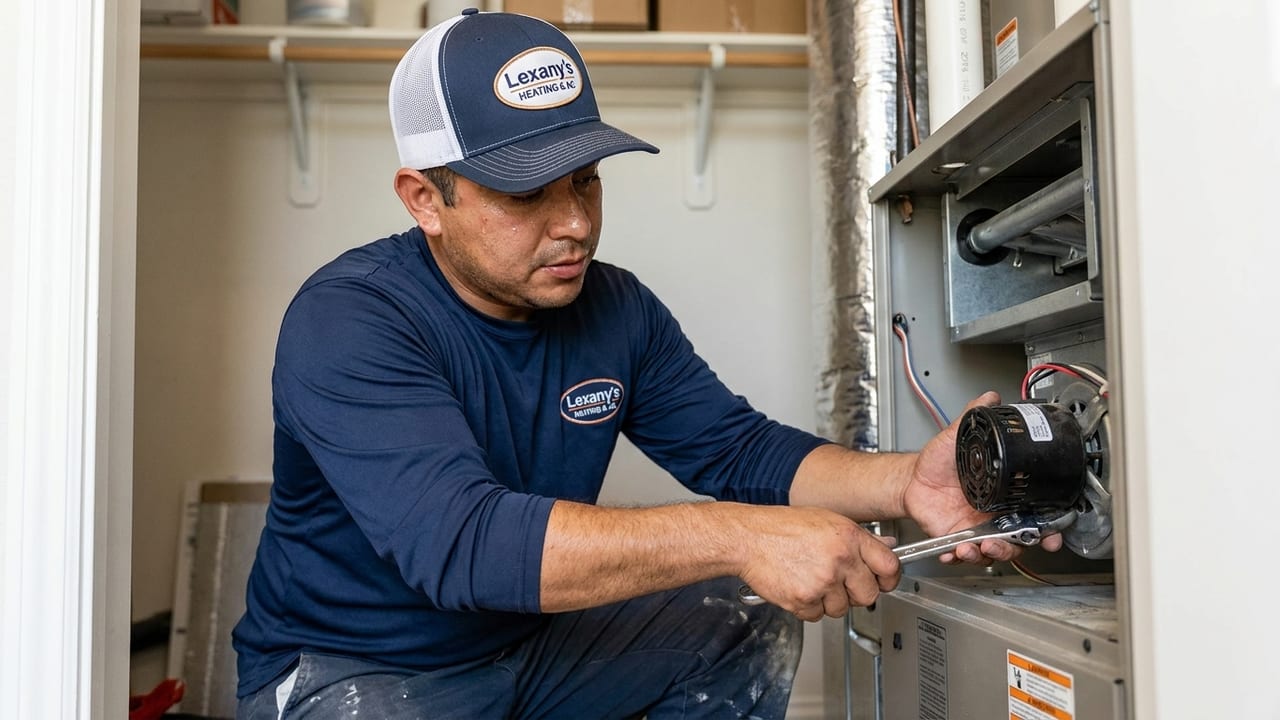
An annual inspection is the other half of the equation. During a seasonal tune-up, a technician examines the heat exchanger for cracks, confirms the flue and venting are clear and intact, checks for clean combustion, and verifies the burner flame looks right. It’s the most reliable way to catch a developing problem before it ever reaches your living space. If something’s already wrong, our heating repair team can address it.
A few everyday precautions
- Keep outdoor vents and flue terminations clear of leaves, debris, snow, and nests
- Never run a generator, grill, or car inside an attached garage or near windows
- Don’t use the oven or stovetop to heat the home
- If a fuel-burning appliance is acting up, stop using it until it’s checked
Don’t wait to investigate or air out the room. Get everyone outside, call 911 from outside, and let the fire department confirm it’s safe. Only then should a licensed technician inspect the furnace and other gas appliances before you use them again.
Heading into a North Texas winter, a quick safety check brings real peace of mind. We service forced-air gas and electric furnaces and heat pumps for homes across the area, and we’re glad to inspect your gas furnace before the heating season. Reach a real person at 469-728-7113. We offer same-day service, work in English and Spanish, hold Texas A/C License #51447, and serve Forney plus nearby Kaufman County towns like Mesquite, Terrell, Kaufman, Heartland, Rockwall, Heath, and Kemp.
Carbon Monoxide FAQs
Can my gas furnace really produce carbon monoxide?
Any appliance that burns fuel — a gas furnace, water-burning appliance, stove, or fireplace — produces some carbon monoxide as a byproduct of combustion. In a healthy system, that CO is carried safely outside through the flue or vent. The danger comes when something fails: a cracked heat exchanger, a blocked or leaking flue, poor combustion, or blocked vents can let CO escape into the home. That’s why an annual inspection of a gas furnace matters so much.
Where should I put carbon monoxide detectors in my home?
General fire-safety guidance is to place a CO alarm on every level of the home and outside each sleeping area, so it can wake you up. Keep them at least a short distance from fuel-burning appliances to avoid nuisance alarms, follow the manufacturer’s height instructions, and test them monthly. Most CO detectors need replacing every five to seven years — check the date on yours.
What should I do if my carbon monoxide alarm goes off?
Treat it as real. Get everyone outside into fresh air immediately, then call 911 from outside — do not go back in to investigate. Carbon monoxide is invisible and odorless, so you cannot judge the danger by how you feel. Once the fire department says it’s safe, have a licensed technician inspect your furnace and other gas appliances before you use them again.
How can I prevent carbon monoxide problems from my furnace?
Two simple things cover most of it: keep working CO alarms in the home and have your gas furnace inspected once a year — a seasonal tune-up is the easy way to do that. During the inspection a technician checks the heat exchanger, confirms the flue and venting are clear and intact, and verifies clean combustion. Keep outdoor vents clear of snow, leaves, and nests, and never run a generator or car in an attached garage.

Owner of Lexany’s Heating & AC. Family-owned in Forney since 2011 — most days he’s the one on the truck doing the work himself. Bilingual (English/Spanish).