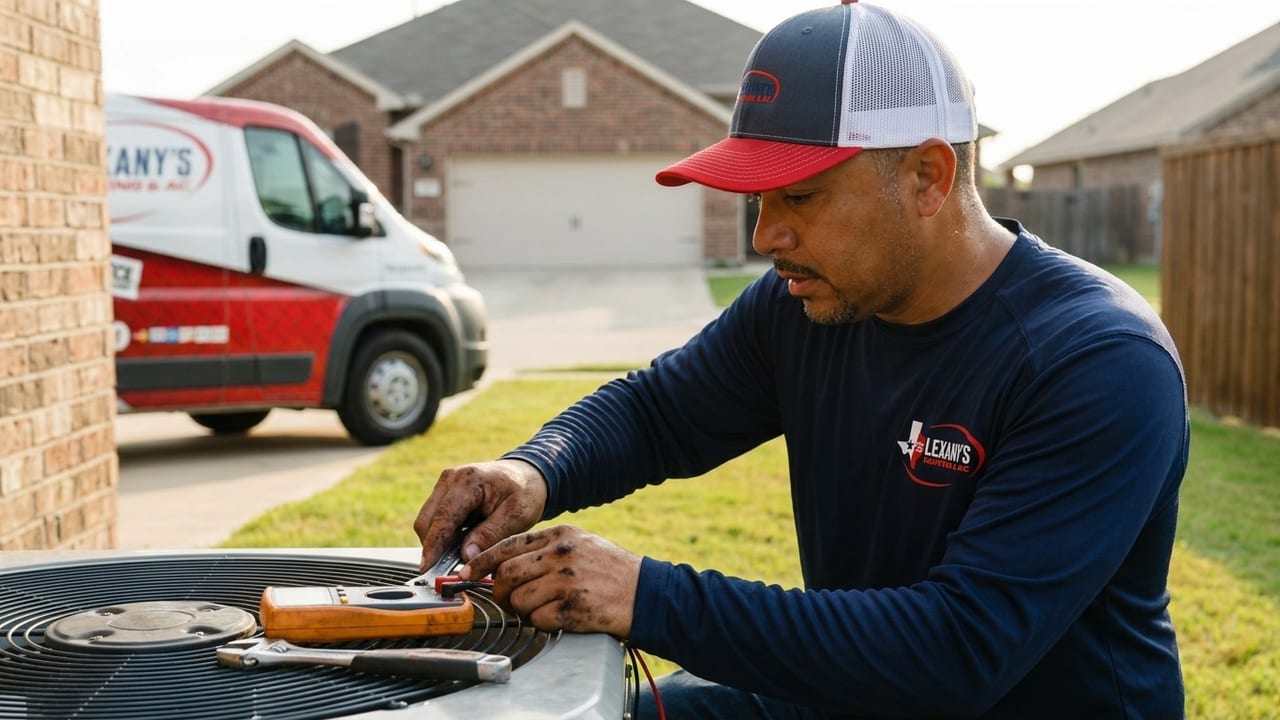
Nobody loves a line item that just sits on the bill every month, and for most Forney homes the air conditioner and furnace are the biggest one. The good news is that a couple of seasonal tune-ups a year are one of the few things that quietly push that number down — and head off the kind of breakdown that always seems to happen on the hottest afternoon of July.
Why a tune-up shows up on your power bill
An HVAC system doesn’t fail all at once. It slips. A film of dust builds on the coils, the refrigerant charge drifts a little low from a slow leak, a wire connection loosens up over a few years of heat-and-cool cycles. The system keeps running and keeps cooling your house — it just has to run longer and pull more power to hit the same setpoint. You don’t feel it. You just see it on the bill, a few dollars at a time, until it isn’t a few dollars anymore.
A seasonal tune-up reverses most of that drift. Clean coils move heat the way they were designed to. A correct refrigerant charge means the compressor isn’t straining. Good airflow means the blower isn’t fighting a clogged filter or a closed-up coil. Tight electrical connections mean motors and capacitors aren’t running hot. Put together, those let the system reach your temperature with less run time — and less run time is the whole game when it comes to your power bill.
What a real seasonal tune-up covers
“Tune-up” gets thrown around loosely, so here’s what we actually do when Gustavo or one of the team comes out. It’s not a quick glance and a sticker on the unit — it’s a real working-over of the system, top to bottom.
- Clean the coils. The outdoor (condenser) coil sheds the heat your house is dumping outside, and the indoor (evaporator) coil pulls heat out of your air. A coil caked in dust, grass clippings, or cottonwood can’t transfer heat efficiently, so the system runs longer for the same result. We clean both.
- Check the refrigerant charge. We measure pressures and confirm the charge is at spec. Too low almost always means a leak — and the fix is to find and repair the leak, not just top it off. A correct charge is one of the biggest factors in how efficiently the system cools.
- Inspect airflow and the blower. We check the filter, the blower wheel, and the ducting for restrictions. Restricted airflow makes the whole system work harder and can ice up the coil in summer.
- Tighten and test the electrical. Loose connections run hot and waste energy; a weak capacitor makes the compressor or fan motor strain. We check connections, test the capacitor and contactor, and read the amp draw against spec.
- Clear the condensate drain. Your AC pulls humidity out of the air, and that water has to drain. A clogged drain line backs up, overflows, and can shut the system down or do water damage. We flush it clear.
- Check the thermostat and the cycle. We confirm the thermostat is reading right and the system starts, runs, and shuts down cleanly — no short-cycling, no strange delays.
- Look the whole system over. Belts, bearings, the contactor, the safety controls — we look for the small worn parts that take minutes to replace now and cost plenty if they strand you in August.
A worn capacitor caught during a spring tune-up is a small, planned part swap. The same capacitor failing on a 100-degree Saturday is an emergency call, a hot house, and a longer wait. Tune-ups turn surprises into scheduled fixes.
Spring for cooling, fall for heat — the cadence
The simple rhythm we recommend for a Forney home is two visits a year, each one timed just ahead of when you’ll lean on that side of the system hardest.
Spring: get the AC ready before summer
This is the important one in our climate. Texas summers are long and brutal, and your air conditioner runs for months at a stretch. A spring tune-up — coil cleaning, charge check, drain flush, electrical — gets the system efficient before the heat lands, so it isn’t limping into the worst of it. It’s also the calmest time to catch a weak part, because we’re not racing the heat to fix it. You can read more on our air conditioning maintenance page.
Fall: get the heat ready before the first cold snap
Our winters are short, but they’re real — a few hard freezes a year, and you want the furnace or heat pump ready when one shows up. A fall heating tune-up checks the burners and heat exchanger on a gas furnace (a safety item as much as an efficiency one), the reversing valve and defrost cycle on a heat pump, and the airflow and controls on both. More on that on our heating maintenance page.
We keep this simple: there’s no contract to sign and nothing to enroll in. Just two seasonal tune-ups a year, booked when it suits you, with an honest look at what your system actually needs.
What you can do between visits
The tune-ups do the heavy lifting, but a few minutes of upkeep between them protects the work and keeps the system breathing easy. None of this needs tools or a tech.
- Change the filter on schedule. During heavy summer running, check it monthly and replace it when it looks dirty. A clogged filter is the single most common cause of weak airflow, higher bills, and a frozen coil. It’s the highest-payoff thing you can do.
- Keep the outdoor unit clear. Give the condenser at least a couple of feet of breathing room on all sides. Pull weeds, trim back shrubs, and brush off grass clippings and leaves so it can shed heat freely.
- Keep supply and return vents open and unblocked. Furniture, rugs, and closed registers choke airflow and make the system work harder — more on why that backfires below in our other posts.
- Listen and look. A new rattle, a musty smell, a longer run time, or a bill that climbs without a reason are all worth a quick call before they grow.
You’ll see all kinds of percentages quoted online for what tune-ups save. Take them as general industry guidance, not a promise — every home, system, and thermostat habit is different. What we’ll stand behind is simpler: a clean, correctly charged, well-airflowed system uses less power and breaks down less than a neglected one.
If it’s been more than a year since anyone looked your system over, spring is the time to fix that — before the Forney heat does the looking for you. Gustavo and the team handle most calls the same day, and you can reach a real person at 469-728-7113. We’re a residential, family-owned shop serving Forney and the nearby Kaufman County towns, we work in English and Spanish, and we hold a Texas A/C License #51447.
HVAC Tune-Up FAQs
How often should I have my HVAC system tuned up?
Twice a year is the cadence we recommend in our part of Texas — a cooling tune-up in spring before the summer load hits, and a heating tune-up in fall before the first real cold snap. Our summers run long and hard, so the spring visit matters most for keeping your bill in check. If you only ever do one a year, make it the spring one.
Will a tune-up really lower my energy bill?
It helps. A clean coil, a correct refrigerant charge, good airflow, and tight electrical connections all let the system reach your setpoint with less run time, and less run time is less power used. Industry guidance generally puts the efficiency a system loses to dirt and neglect in the double digits over a season. We won’t promise you an exact dollar figure — every home is different — but a well-kept system almost always shows up as a smaller electric bill.
Do I still need a tune-up if my system seems to be working fine?
Yes. Most efficiency loss is gradual and invisible — a coil films over with dust, the charge drifts a little low from a slow leak, a connection loosens. The system still cools, it just costs more and works harder to do it. A tune-up catches those quiet problems before they turn into a hot-afternoon breakdown, which is the most expensive way to find out something was wrong.
What does a tune-up cost?
Pricing depends on the system and what we find, so the honest answer is it depends on the system and what we find. What we can tell you is there are no surprises — we look the system over, tell you what it needs in plain language, and you decide. Give us a call at 469-728-7113 and we’ll walk you through it.

Owner of Lexany’s Heating & AC. Family-owned in Forney since 2011 — most days he’s the one on the truck doing the work himself. Bilingual (English/Spanish).