“What size AC do I need?” is one of the first questions we hear, and it’s the right one to ask — an air conditioner that’s even a half-ton off the mark will cost you in comfort and on your electric bill for the life of the system. The honest answer is that size depends on your specific home, not a number you can pull from a chart. Here’s how we figure it out for Forney homes.
Tonnage and the rule of thumb
AC capacity is measured in tons, and you’ll often see a rule of thumb like “one ton per 500 to 600 square feet.” That math is a starting point, nothing more. It treats every home the same, when a shaded brick house with new windows and a sun-baked home with single-pane glass of the same size need very different equipment. Use the rule of thumb to ballpark the conversation, then put it aside before you buy.
One ton of cooling equals 12,000 BTUs of heat removed per hour. Most Forney homes land between 2 and 5 tons — but the exact figure comes from your house, not its square footage alone.
What actually decides the right size
The real number comes from how your home gains and holds heat across a Texas summer. Square footage is just one input. Here’s what moves the size up or down.
Add mature shade trees, the color and material of your roof, and how many people live in the home, and you can see why two houses with identical floor plans can need different systems. Forney’s mix of newly built homes and older properties makes this especially true block to block.
Why a Manual J load calculation is the real answer
A Manual J load calculation is the industry standard for getting the size right. It takes all of those factors — square footage, insulation, windows, ductwork, sun exposure, ceiling height and more — and calculates how much heat your home actually gains on a design summer day. The output is a cooling load in BTUs that maps to a specific tonnage, matched to your house rather than an average one.
If a contractor quotes you a size by glancing at the old unit or asking only for your square footage, ask why they skipped the calculation. A proper load calc is the difference between a system that fits and one you’ll fight with for fifteen years.
Why bigger isn’t better
It’s tempting to think a larger AC means more comfort. The opposite is usually true. An oversized system cools the air fast, hits the thermostat target, and shuts off — over and over in short bursts. That’s called short-cycling, and it has two costs. First, the equipment never runs long enough to pull humidity out of the air, so the house feels cool but clammy and sticky. Second, all that stopping and starting wears the compressor and drives up your bill.
An undersized system has the opposite problem: it runs nonstop and still can’t keep up when Forney hits triple digits in July. The right size runs in long, steady cycles that hold both the temperature and the humidity right where you want them. That’s the whole goal of sizing — not the biggest number, the correct one.
Once the size is settled, the next question is how efficient to go. Our SEER savings calculator and our SEER2 guide can help you weigh that before you buy.
Our free in-home sizing
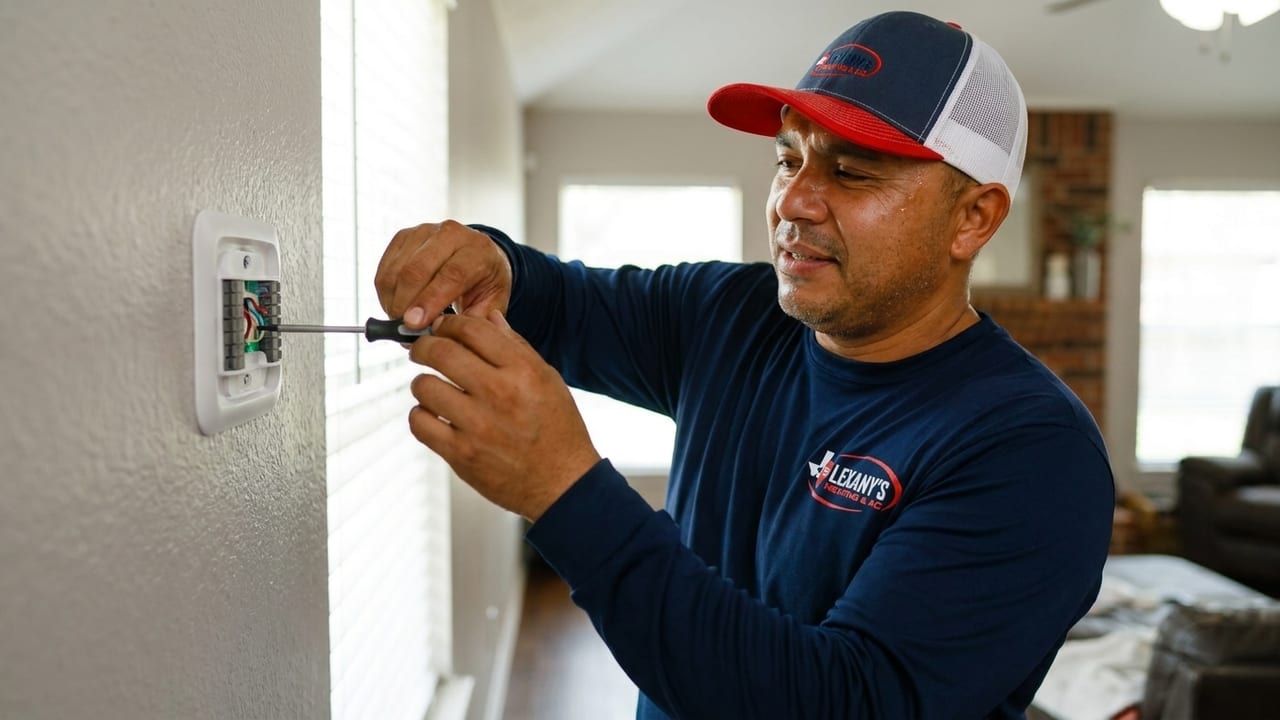
You don’t have to figure any of this out on your own. When you’re considering a new system, we come out, measure the rooms, check insulation and ductwork, note your windows and sun exposure, and run the numbers — at no charge and with no pressure. You get an honest recommendation and a written quote you can compare. If you’d rather start with repair, our AC repair team can also tell you whether a replacement even makes sense yet.
Sizing should never be a guess. If you want your Forney home measured the right way, give us a call at 469-728-7113 — we offer same-day service most days, in English and Spanish, and we cover Forney along with Mesquite, Terrell, Kaufman, Heartland, Rockwall, Heath and the nearby Kaufman County towns. Family-owned since 2011, TX A/C License #51447.
AC sizing FAQs
Can’t I just match the size of my old unit?
Sometimes the old unit was sized wrong to begin with, and your home may have changed — new windows, added insulation, a remodel. We confirm the load rather than copy the tag on a system that might have been struggling for years.
What does “tonnage” actually mean?
A ton is a measure of cooling capacity, not weight. One ton equals 12,000 BTUs of heat removed per hour. Most Forney homes land somewhere between 2 and 5 tons, but the exact number depends on your specific house, not just its size.
How long does a sizing visit take?
Usually under an hour. We measure rooms, check insulation and ductwork, note window and sun exposure, then walk you through the result. Call 469-728-7113 to set it up — most days the same day.

Owner of Lexany’s Heating & AC. Family-owned in Forney since 2011 — most days he’s the one on the truck doing the work himself. Bilingual (English/Spanish).