When you start shopping for a new air conditioner, “SEER2” shows up on every spec sheet and most sales pitches — usually with a push toward the biggest number. Here’s what the rating really means for a Forney home, where it pays off, and why the people doing the install matter just as much as the figure on the box.
What SEER2 actually is
SEER2 stands for Seasonal Energy Efficiency Ratio, version two. It’s the 2023 update to the older SEER rating, and it measures how much cooling a system delivers across a whole season for the electricity it uses. A higher number means more cooling per watt — in other words, less power for the same comfort.
The “2” matters. The updated test uses tougher, more realistic conditions that better reflect how equipment behaves in a real house with real ductwork. Because of that, a SEER2 figure runs a little lower than the old SEER figure for the very same unit. It isn’t a downgrade — it’s just a more honest yardstick, so don’t compare a new SEER2 number directly against an old SEER one.
How the rating maps to your bill
Think of SEER2 like miles per gallon for your AC. A higher-rated system does the same cooling work while pulling less electricity, so the monthly bill is smaller. The catch is the same as with a fuel-efficient car: the savings only stack up if you actually drive a lot of miles. In Texas, we do — the cooling season here runs long and hard, which is exactly the condition where a more efficient system has the most room to pay you back.
It helps to think in two buckets. There’s the upfront cost — what you pay to put the system in — and the running cost, which is what shows up on your electric bill month after month for the next decade and more. A higher SEER2 number trades a bigger upfront cost for a smaller running cost. The decision is really about which of those two numbers you’d rather keep down, given how long you’ll own the home and how hard you lean on the AC.
Why the savings are bigger here than up north
A point or two of SEER2 barely moves the needle for a homeowner who only runs cooling a few weeks a year. In Kaufman County, where the AC carries the house from spring well into fall, those same points get multiplied across thousands of run-hours. The hotter and longer your cooling season, the more an efficient system has to work with — and ours is about as long as it gets. That’s the single biggest reason efficiency deserves a real look in a Forney home, even though it costs more on day one.
A higher SEER2 system costs more upfront and gives it back slowly through lower bills. The question is never just “how efficient” — it’s “how long until the savings catch up to the extra cost.”
Which tier fits a Texas summer
There’s no single right answer, but the long Kaufman County cooling season tilts the math toward efficiency more than it would in a milder climate. Use the tiers below as a starting point, then match them to your own situation.
Higher tiers often pair with two-stage or variable-speed equipment, which can run in longer, gentler cycles. That tends to feel more comfortable and pull more humidity out of the air — a real benefit on a muggy Texas afternoon — though it also adds to the upfront cost.
How long you’ll stay changes the math
This is the question most worth answering honestly before you spend a dollar. If you plan to be in the home for ten or more years and you run the AC the way most of us do here, a step up in efficiency has time to earn back its higher price through lower bills. If you might move in a few years, that payback window may close before you ever see it, and a standard-efficiency system can be the smarter buy. The “best” SEER2 isn’t the highest one — it’s the one whose savings catch up to its cost while you still own the house.
Why the install matters as much as the number
Here’s the part the spec sheet won’t tell you: a system only delivers its rated efficiency if it’s sized and installed correctly. A high SEER2 unit that’s oversized, charged wrong, or hooked to leaky ductwork will quietly underperform its sticker every single day. The rating is measured in a lab under ideal conditions; your house is not a lab.
We see this play out all the time. A homeowner pays for a premium, high-efficiency system, then watches their bills land higher than they expected — because the ductwork leaks conditioned air into the attic, or the refrigerant charge was never dialed in, or the unit was a size too big and short-cycles all summer. The equipment was never the problem. Put plainly: a well-installed mid-tier system will usually beat a sloppily installed high-tier one on your actual bill. So when you compare quotes, don’t just compare SEER2 numbers — ask what each contractor will do to make sure the system performs the way it’s rated.
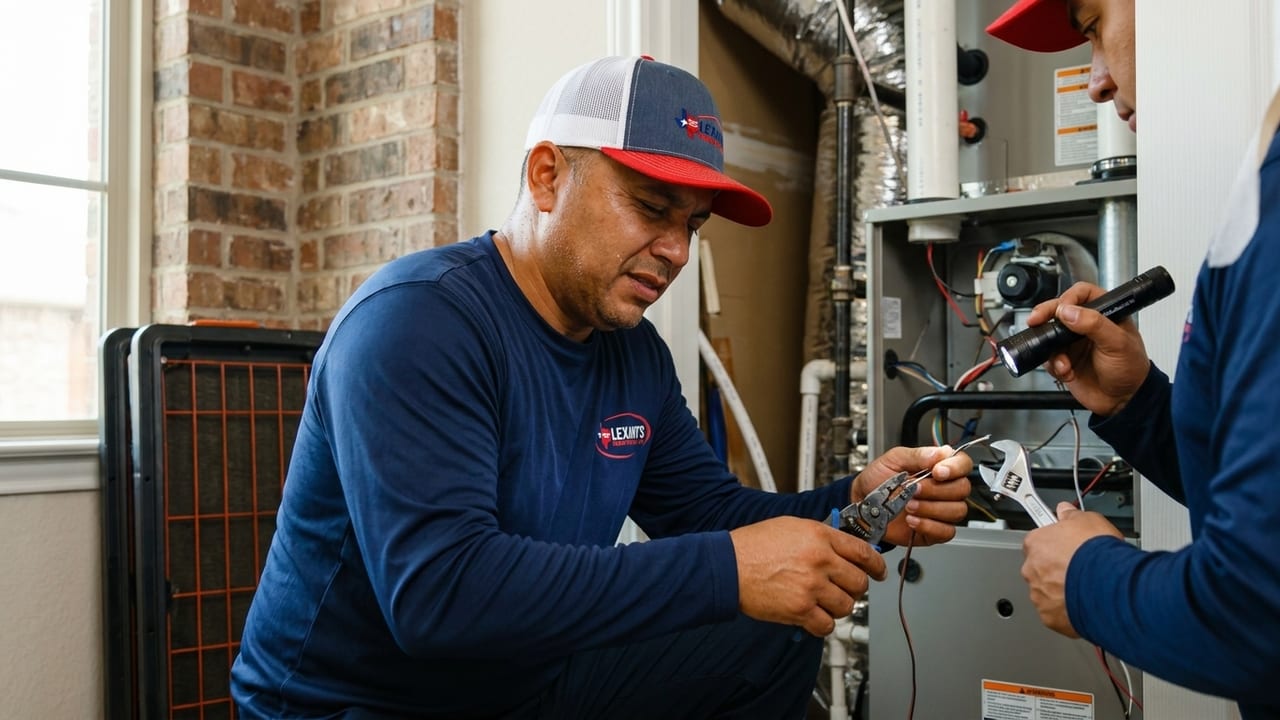
That’s why we start with the home, not the box. A proper load calculation, sealed ductwork, a correct refrigerant charge and a clean airflow setup are what let the efficiency you paid for actually show up on your bill. If you want to dig into sizing, our guide on sizing and our broader buying guide walk through it, and you can explore financing or run rough numbers with our savings calculator. (We quote specific equipment pricing after we’ve seen your home.)
If you’d like a straight answer on which SEER2 tier makes sense for your home — without the hard sell — give us a call at 469-728-7113. We offer same-day service in English and Spanish across Forney and the nearby Kaufman County towns. Lexany’s Heating & AC is family-owned, residential-only, and licensed in Texas (A/C License #51447).
SEER2 FAQs
Is a higher SEER2 always worth the extra money?
Not always. In Texas, where the AC runs most of the year, a step up in efficiency can pay off over time — but only if you stay in the home long enough and the system is sized and installed right. We’ll give you an honest read for your situation rather than pushing the biggest number.
What’s the difference between SEER and SEER2?
SEER2 is the updated rating that took effect in 2023. It uses tougher, more realistic testing conditions, so a SEER2 number runs a little lower than the old SEER number for the same equipment. It’s not a downgrade — it’s just measured more like the real world.
Does a high SEER2 system cool my house faster?
No. Efficiency is about how little power the system uses to do its job, not how fast it cools. Comfort comes from the right size and a clean install — a high SEER2 unit that’s oversized or poorly installed won’t feel any better.

Owner of Lexany’s Heating & AC. Family-owned in Forney since 2011 — most days he’s the one on the truck doing the work himself. Bilingual (English/Spanish).