When you get a quote or a service ticket for your heating and cooling, it can read like a foreign language — SEER2, AFUE, tonnage, MERV. None of it is complicated once someone explains it plainly, and that’s exactly what this glossary does. Here are the terms we hear homeowners ask about most, grouped so they’re easy to find.
Efficiency & rating terms
These are the numbers that tell you how efficiently a system turns energy into heating or cooling. Higher ratings generally cost more upfront and use less power over time. Here’s how the main ones stack up.
SEER2 and HSPF2
SEER2 (Seasonal Energy Efficiency Ratio 2) rates cooling efficiency; HSPF2 (Heating Seasonal Performance Factor 2) rates a heat pump’s heating efficiency. The “2” reflects updated federal test standards that better mirror real-world conditions. We cover the cooling side in more depth in our SEER2 guide, and you can estimate savings with our SEER savings calculator.
AFUE
AFUE (Annual Fuel Utilization Efficiency) applies to gas furnaces and is shown as a percentage. A 90% AFUE furnace turns 90 cents of every fuel dollar into heat for your home and loses the rest. It’s the heating equivalent of miles per gallon.
MERV
MERV (Minimum Efficiency Reporting Value) rates how well a filter captures airborne particles, from around 1 to 16 on residential equipment. A higher MERV cleans the air more thoroughly, but a filter that’s too restrictive for your system can choke airflow — so it’s worth asking what your equipment is rated for.
Equipment & parts
These are the physical pieces of your system — the things a technician points to when they explain what’s going on under the hood.
Tonnage & BTU
A “ton” is a measure of cooling capacity, not the unit’s weight — one ton equals 12,000 BTU per hour. A typical Forney home runs somewhere in the 2- to 5-ton range depending on size and insulation. BTU (British Thermal Unit) is the underlying measure of heating or cooling energy. The right capacity comes from a load calculation, not from guessing.
Condenser, evaporator coil & air handler
The condenser is the outdoor unit that releases heat from your home. The evaporator coil sits indoors and absorbs heat and humidity from the air passing over it. The air handler is the indoor blower assembly that moves conditioned air through your ducts. Together they make up the loop that keeps your home comfortable.
Compressor & capacitor
The compressor is the heart of the outdoor unit — it pumps refrigerant through the system, and it’s one of the costliest parts to replace. The capacitor is a small component that gives the motors the jolt they need to start; it’s a common, affordable failure we catch on a tune-up before it leaves you without cooling on a hot day.
Heat pump
A heat pump is a single system that both cools and heats by moving heat rather than burning fuel — it pulls heat out of your home in summer and into it in winter. They’re a popular, efficient option in our climate. On the heating side, the systems we service are forced-air gas and electric furnaces and heat pumps (including propane and dual-fuel setups). You can read more on our heating page.
Ductless mini-split
A ductless mini-split delivers heating and cooling without ductwork, using an outdoor unit linked to one or more indoor wall units. It’s a good fit for additions, garages, or rooms a central system struggles to reach.
Refrigerant (R-410A)
Refrigerant is the fluid that carries heat in and out of your home as it cycles between liquid and gas. R-410A has been the common residential refrigerant for years, though the industry is shifting to newer, lower-impact blends. If your system is low on refrigerant, that points to a leak we need to find and fix — topping it off without finding the cause just hides the problem.
Service & sizing terms
Finally, the terms you’ll hear on a sizing visit or a service call.
Load calculation (Manual J)
A Manual J load calculation figures out exactly how much heating and cooling your home needs based on its size, insulation, windows and orientation. It’s the right way to size a new system, and it beats eyeballing the old unit every time.
Thermostat & zoning
The thermostat is the control that tells your system when to run. Zoning divides a home into areas with separate controls, so you can keep an upstairs bedroom and a downstairs living room at different temperatures without running two systems.
Condensate drain
As your AC pulls humidity from the air, that moisture has to go somewhere — the condensate drain carries it away. A clogged drain is one of the most common causes of a no-cool call and water around the indoor unit, and it’s easy to clear during a seasonal tune-up.
When you compare proposals, line up the tonnage and the efficiency rating (SEER2 for cooling, AFUE or HSPF2 for heating) on each one. If two quotes use different sizes, that’s the first thing to ask about.
If you’d like any of these terms explained for your own system, call us at 469-728-7113. We provide same-day service in English and Spanish across Forney and the nearby Kaufman County towns. Lexany’s Heating & AC is family-owned, residential-only, and Texas-licensed (A/C License #51447).
HVAC glossary FAQs
Why do quotes use so many abbreviations?
A lot of them are efficiency ratings the government and manufacturers require — SEER2, AFUE, HSPF2. They’re useful once you know what they mean, which is the whole point of this glossary. If anything on your quote is unclear, call us and we’ll explain it line by line.
Do I need to memorize any of this?
Not at all. The terms here just help you ask better questions and compare quotes fairly. A good contractor should be able to explain every line of a proposal in plain language, and we’re always happy to do that.
What’s the most important number to look at?
For cooling it’s usually the SEER2 rating and the correct tonnage for your home; for heating it’s AFUE on a gas furnace or HSPF2 on a heat pump. But the right size for your specific Forney home matters more than chasing the highest rating — an oversized system underperforms no matter how efficient it’s rated.
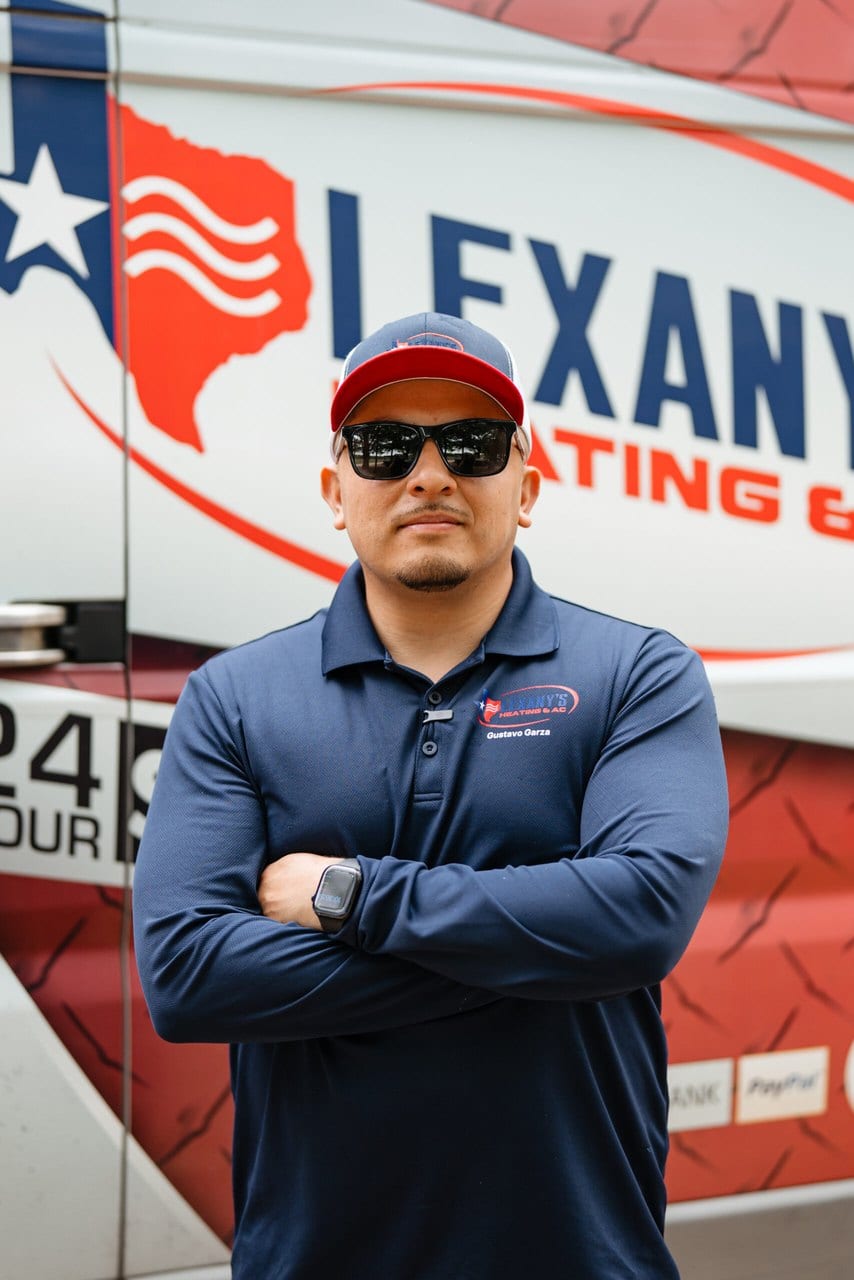
Owner of Lexany’s Heating & AC. Family-owned in Forney since 2011 — most days he’s the one on the truck doing the work himself. Bilingual (English/Spanish).