If you are looking at a new HVAC system for your Forney home, the options can feel overwhelming fast. Heat pump or furnace? Central or ductless? Gas or electric? The short answer is that there is no one right system for every house — but there is a right system for your house. Here is a plain walkthrough of what each type does, which homes and situations it fits best, and how to think through the decision.
What Forney weather means for your system choice
Forney sits in North Texas — which means long, genuinely hot summers, short and mostly mild winters, and a handful of hard-freeze nights each year. That climate matters when you are choosing equipment because the system that is ideal for Minneapolis winters is not necessarily the best call here. Our cooling season does the heavy lifting. Heating is real but brief — which is why a lot of the equipment that makes sense in colder states (high-capacity gas furnaces paired with a separate AC system) is not always the most efficient path for a Forney home.
That said, every home is different. Square footage, ductwork condition, insulation, windows, how many people live there — all of it shapes which system performs best and costs the least to run.
Central split AC + furnace
This is what most existing Forney homes already have: a split system with an outdoor condenser, an indoor air handler or furnace, refrigerant lines between them, and ductwork throughout the house. In summer the AC pulls heat out; in winter the furnace pushes warm air through the same ducts. Two separate pieces of equipment, one delivery system.
Best fit for
- Homes with existing ductwork in reasonable shape
- Owners who want a familiar system and straightforward repairs
- Homes where natural gas is available and the heating load is moderate
- Full-house replacement when both the AC and the furnace are at end of life
A central split system gives you the widest choice of equipment, the most contractors who can service it, and parts availability that keeps repair costs predictable. The main limitation is the ductwork: if yours is leaky, undersized, or poorly routed, even a brand-new system will underperform — and that is worth addressing before or during the install, not after.
Heat pumps
A heat pump looks like a central AC from the outside — same outdoor unit, same indoor air handler, same ductwork. The difference is that it can run in reverse. In summer it pulls heat out of your home exactly like an air conditioner. In winter it extracts heat from the outdoor air (there is usable heat out there even on cold days) and brings it inside. One system does both jobs.
Best fit for
- All-electric homes, or homes where avoiding a gas line is a priority
- Homeowners replacing both the AC and the furnace at the same time
- Forney homes where efficiency through our mild-to-moderate winters matters
- Dual-fuel setups: a heat pump handles the cooling season and most of winter; a gas furnace takes over on the few nights it gets truly cold
Our North Texas climate suits heat pumps well. The deep-cold days that stress a heat pump are infrequent here, and the long cooling season means the unit earns its keep all summer doing the same job any AC would do. For the handful of hard-freeze nights, backup heat — either electric strips built into the air handler, or a dual-fuel gas furnace — fills the gap. Done right, you never notice the handoff.
Pairing a heat pump with a gas furnace is a deliberate setup, not a fallback. The heat pump handles everything efficiently until outdoor temps drop below its peak-efficiency range, then the gas furnace takes over cleanly. Many Forney homeowners get the best of both systems this way.
Ductless mini-splits
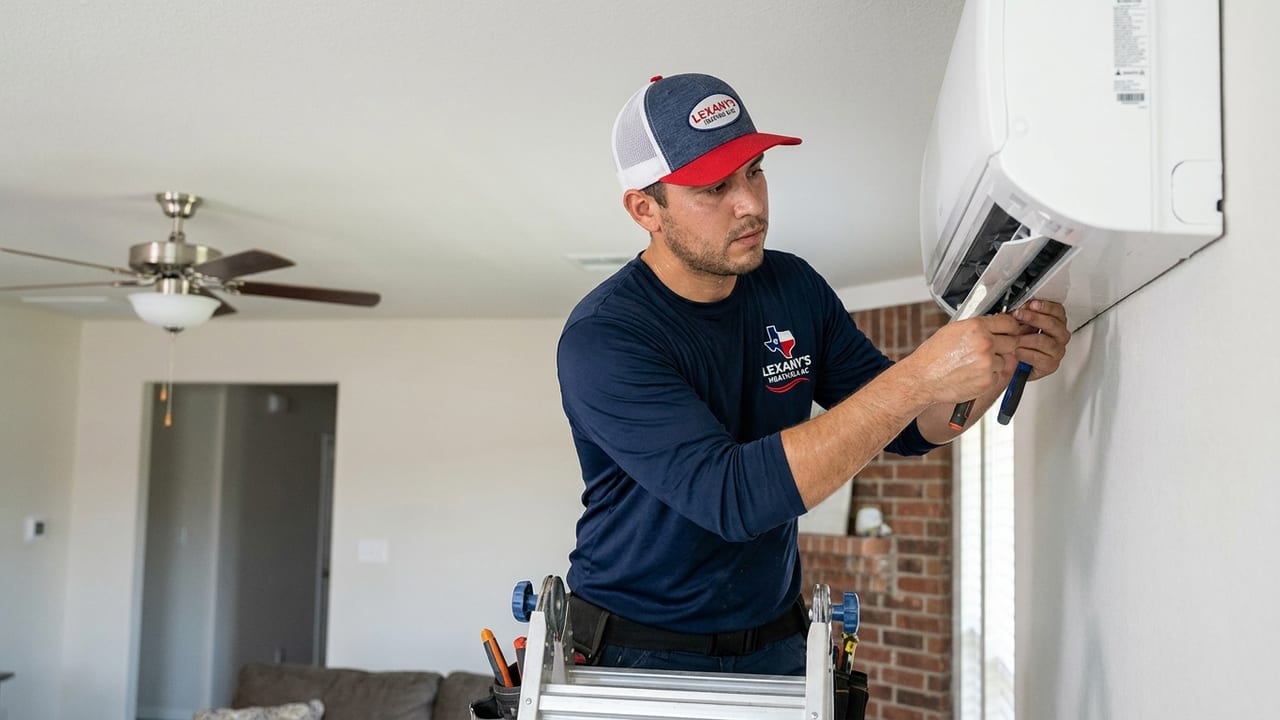
A ductless mini-split is a heat pump without the ductwork. The outdoor unit connects directly to one or more wall-mounted indoor heads via a small conduit through the wall. Each indoor head controls its own zone independently. No ducts, no trunk lines, no attic runs.
Best fit for
- Additions, garages, or sunrooms that the central system does not reach
- Homes without existing ductwork (older construction, slab homes with no attic route)
- Single rooms that run hot or cold no matter how the central system is set
- Workshops, home offices, or converted spaces where extending ductwork is impractical
Mini-splits are not usually the right answer if you have a well-functioning central system and just want a whole-home replacement — the per-room cost adds up, and ductwork you already have is an asset. But for the specific problem of a room or structure the central system cannot adequately serve, a mini-split is often the cleanest and most efficient fix available.
Gas vs. electric furnaces
If you are going with a central split system, you will choose between a gas furnace and an electric furnace for the heating side.
Gas furnace
Burns natural gas to produce heat, then moves it through your ducts with a blower. Fast to heat, powerful, and — for most Forney homes on gas lines — less expensive to run per BTU than electric resistance heat. The most common choice for existing homes with gas service already in place. Requires a flue or sealed combustion exhaust and should be inspected seasonally.
Electric furnace
Uses electric heating elements the same way a space heater does, just scaled up and integrated into your ductwork. No gas line, no combustion exhaust, simpler mechanically. A solid fit for all-electric homes or situations where running a gas line is not practical. Operating cost depends on your electricity rate; in Texas those rates can vary significantly, so it is worth running the numbers for your home before you decide.
Goodman is the equipment we install most and know best — well-priced, reliable, and parts are easy to source in North Texas, which keeps your future repair costs down. We also install and service the other major brands homeowners already own or ask for. What matters far more than the logo is that the system is sized correctly and installed cleanly.
How to decide which system fits your home
There is no chart that replaces a real conversation about your house, but these questions get you most of the way there:
- Do you have ductwork, and is it in decent shape? Good ducts point toward a central split or heat pump system. No ducts, or a single problem room, points toward a mini-split.
- Is natural gas available at your home? If yes, gas heat is usually the cost-efficient choice for the furnace side. If you are all-electric or going electric intentionally, a heat pump or electric furnace fits the bill.
- Are you replacing one piece or the whole system? If both the AC and the furnace are at end of life at the same time, it is worth looking at a heat pump as a single replacement for both. If one is still in good shape, a matched replacement for the failing unit is usually the smarter move.
- What are you trying to fix? A room that never gets comfortable, a high electric bill, a system that short-cycles, a space without any ductwork at all — the problem defines the best solution more than the product category does.
- What does the load calculation say? This is the non-negotiable step. Sizing an HVAC system on square footage alone leads to units that are too big (short-cycle, poor humidity control, early wear) or too small (runs nonstop, never catches up on the hottest days). A real Manual J load calculation accounts for your insulation, windows, orientation, and ceiling height — that is how the right size gets determined.
System type at a glance
The right system is the one sized and matched to your home. When you call Lexany’s, you are usually talking directly to Gustavo — the owner who has been doing this work in Forney since 2011. He will tell you what he actually recommends for your house, give you an upfront quote, and most of the time can get out there the same day. TX A/C License #51447, NATE Certified, bilingual English and Spanish.
HVAC System FAQs
Can a heat pump handle a Texas winter?
Yes — for most of our Forney winters, a properly sized heat pump handles the heating load comfortably and efficiently. Modern units stay effective well into the 30s. For the handful of hard-freeze nights we get each year, they are paired with electric backup heat or, in a dual-fuel setup, a gas furnace that takes over below a set outdoor temperature.
Is a ductless mini-split worth it if I already have central AC?
It depends on the problem you are solving. If you have a room or addition that the central system cannot reach well — a garage apartment, a sunroom, a bedroom over the garage — a mini-split is often a cleaner and more efficient fix than trying to extend the ductwork. If the whole house is uncomfortable, a load calculation on the central system is the better first step.
Gas or electric furnace for a Forney home?
For most Forney homes connected to natural gas, a gas furnace is the common choice because gas heat is typically less expensive per BTU in Texas. Electric furnaces are simpler and have no combustion exhaust, making them a solid fit for all-electric homes or additions where running a gas line is not practical. We will walk you through the tradeoffs for your specific home.
How do I know if my system is the wrong size?
Short-cycling is the clearest sign of an oversized system — it starts, cools or heats the air quickly, then shuts off before the humidity and temperature fully stabilize. An undersized system runs almost continuously and still falls behind on the hottest or coldest days. Both situations point to a load calculation, not just a replacement swap.

Owner of Lexany’s Heating & AC. Family-owned in Forney since 2011 — most days he’s the one on the truck doing the work himself. Bilingual (English/Spanish).