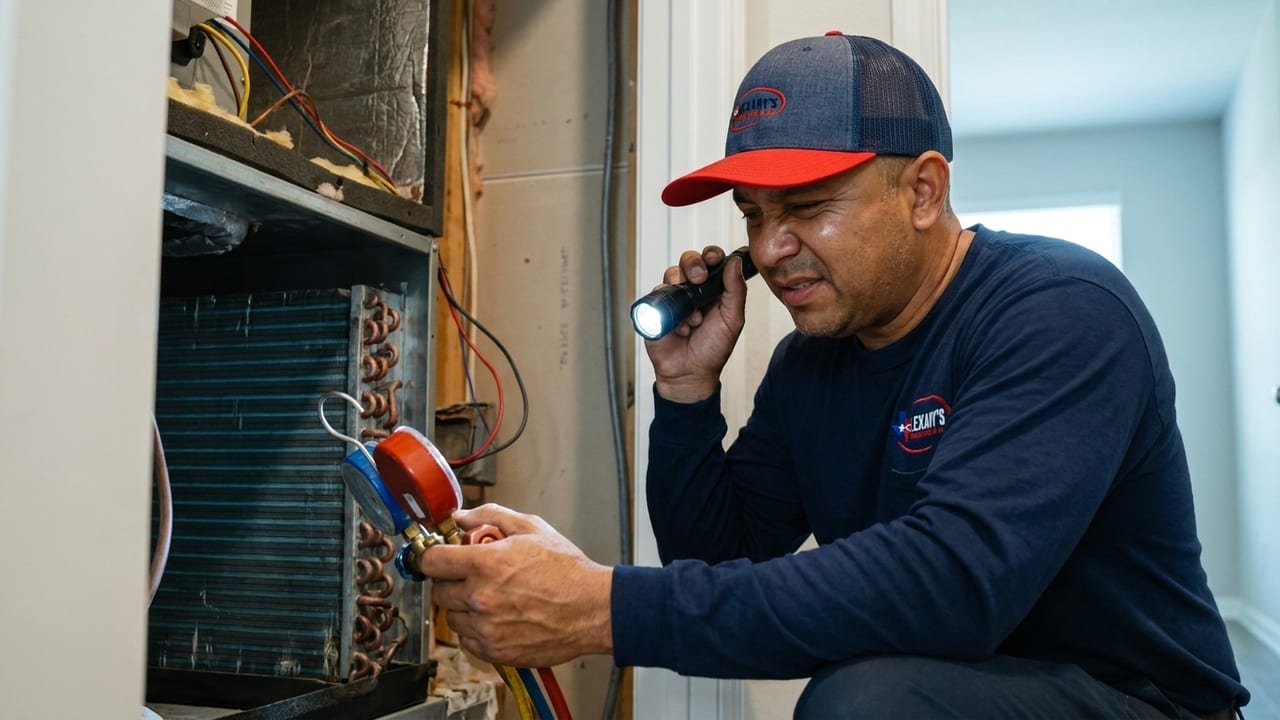
An air conditioner rarely dies without warning. Most of the time it drops hints for days or weeks first — airflow that feels off, a new noise, a bill that’s creeping up. Catching those early is the difference between a small fix and a July afternoon with no cool air. Here’s what to watch for, the three things you can safely check on your own, and when it’s time to call a tech.
The warning signs your AC needs repair
These are the signals we see most often on repair calls around Forney and across Kaufman County. One on its own might be minor; several together usually means something needs attention before the next heat wave.
Weak or warm airflow from the vents
If the system is running but the air feels thin, or it’s coming out room-temperature instead of cold, the unit has lost some of its ability to move heat out of your home. Weak airflow often traces back to a clogged filter or a dirty blower; warm air points to a refrigerant problem, a frozen coil, or a struggling compressor. Either way, your AC is working harder for less result.
Short cycling — turning on and off too often
A healthy system runs in steady cycles. If yours kicks on, runs for a minute or two, shuts off, then starts again a few minutes later, that’s short cycling. It can come from a clogged filter, low refrigerant, a failing control board, or a unit that’s oversized for the home. Short cycling wears out parts fast and never quite cools the house, so it’s worth running down early.
Water pooling or ice on the unit
Water around the indoor air handler usually means the condensate drain line is clogged — left alone, that can damage drywall and grow mold. Ice on the refrigerant lines or the indoor coil is the opposite problem and a bigger red flag: it means the coil has dropped below freezing, almost always from blocked airflow or low refrigerant. If you see ice, turn the system off and let it thaw completely before running it again. Running a frozen coil can kill the compressor.
New or loud noises
A rattle usually means something loose — a panel, a fan blade, or debris in the outdoor unit. Grinding points to worn motor bearings. A loud hum or repeated clicking on startup can signal a failing capacitor or relay. A clean AC is fairly quiet; a new noise that sticks around is the system telling you a part is wearing out.
Musty or burning smells
A musty smell when the AC runs usually means mold or mildew on a damp coil or in the drain pan. A burning or hot-electrical smell is more urgent — it can be insulation, a failing capacitor, or a motor overheating. If you smell burning, shut the system off at the thermostat and call. Don’t keep running it.
Energy bills climbing for no clear reason
When a system has to fight a dirty coil, low refrigerant, or a tired compressor, it draws more power for the same — or less — cooling. If your summer bill is noticeably higher than last year and your habits haven’t changed, that quiet creep is often the first measurable sign of a problem worth catching before it becomes a breakdown.
The breaker keeps tripping
An AC that trips its breaker once might just have caught a power surge. An AC that trips it repeatedly is pulling too much current — a sign of a failing motor, a shorted compressor, or a wiring fault. Resetting the breaker over and over isn’t a fix; it’s a warning. Repeated trips are an electrical problem and a tech’s job, not something to keep overriding.
Most of these problems are smaller repairs at the “weak airflow” or “new noise” stage than after the compressor gives out in 100°F heat. A spring season tune-up before summer hits is the best way to catch the small stuff first.
Three things you can safely check first
Before you call, three checks are quick, free, and genuinely worth doing. They won’t fix a refrigerant leak or a bad motor — but they clear the common false alarms, and if a tech does need to come out, you’ll have given us a cleaner starting point.
- Replace or clean the air filter. A clogged filter chokes airflow and is the single most common cause of weak cooling and a frozen coil. Pull yours out and hold it up to the light — if you can’t see through it, swap it. In a Forney summer, check it monthly while the AC runs hard.
- Confirm the thermostat settings. Make sure it’s set to Cool (not Heat or Fan), the setpoint is actually below the room temperature, and — if it’s battery-powered — the batteries aren’t dead. It sounds obvious, but a bumped setting or a “Fan On” switch fools more homeowners than you’d think, and it costs nothing to rule out.
- Check the breaker and the condensate drain. Look at the electrical panel and the outdoor disconnect to see whether anything tripped — reset it once if it did. Then glance at the condensate drain near the indoor unit; if you see standing water or the float switch has shut the system down, a clogged drain is often the cause. Clearing visible debris around the outdoor unit (give it two feet of clearance) helps too.
When to stop and call a tech
Refrigerant and electrical work aren’t homeowner territory. Handling refrigerant without an EPA Section 608 certification is a federal violation in Texas, and a charged capacitor can deliver a dangerous shock even with the power off. Stop and call a tech for:
- Warm air from the vents after you’ve confirmed the filter is clean and the settings are right
- Ice on the refrigerant lines or coil — especially if it returns after thawing
- A breaker that trips again after you’ve reset it once
- Grinding, a burning smell, or any odor that isn’t just “dusty”
- Short cycling that doesn’t stop after a fresh filter
- A bill that’s jumped without any change in how you use the system
If the refrigerant is low, there’s a leak — adding more without finding and fixing it just delays the next problem and can damage the compressor. The right repair is to locate the leak, fix it, pressure-test, then recharge to spec. That’s the difference between a real fix and a band-aid. See our AC repair page for how we approach it.
Minor fix or call a pro — a quick reference
Some of what looks alarming is a five-minute homeowner fix. The rest needs a licensed tech and the right tools. Here’s the quick split.
When it’s time to call, Gustavo and the team handle most repair calls around Forney the same day — and you’ll reach a real person at 469-728-7113. We’re residential-only, hold a Texas A/C License #51447, are NATE certified, and we work in English and Spanish across Forney, Mesquite, Terrell, Kaufman, Heartland, Rockwall, Heath, and Kemp.
AC Repair FAQs
Why is my AC running but not cooling the house?
If the system is running but the air feels warm or barely cool, start with the easy stuff: confirm the thermostat is set to Cool with the setpoint below room temperature, and check that the air filter isn’t clogged. If both are fine, the usual culprits are a dirty or iced-over coil, low refrigerant from a leak, or a failing capacitor or compressor. Those last few need a licensed tech — not a DIY fix.
Should I repair my air conditioner or replace it?
It depends on the age of the system, the cost of the repair, and how often it’s been breaking down. As a general rule of thumb, a single repair on a system under about ten years old is usually worth doing. Repeated breakdowns on an older unit, or a major part like the compressor failing, can tip the math toward replacement. Gustavo will give you an honest read on which way makes sense for your home — and we put estimates in writing before any work starts.
How often should I change my AC filter in a Forney summer?
During peak cooling season, check a standard one-inch filter every month and replace it when it looks dirty. In a Forney, TX home running the AC hard through July and August, a filter can clog faster than the box says. A dirty filter is the single most common cause of weak airflow and a frozen coil, and a fresh one every month or two prevents it.
Can I add refrigerant to my AC myself?
No. Handling refrigerant requires an EPA Section 608 certification in Texas, so it isn’t a homeowner job. More to the point: if the refrigerant is low, there’s a leak somewhere. Topping it off without finding the leak just delays the next failure and can damage the compressor. A licensed tech finds the leak, repairs it, then recharges to spec.

Owner of Lexany’s Heating & AC. Family-owned in Forney since 2011 — most days he’s the one on the truck doing the work himself. Bilingual (English/Spanish).