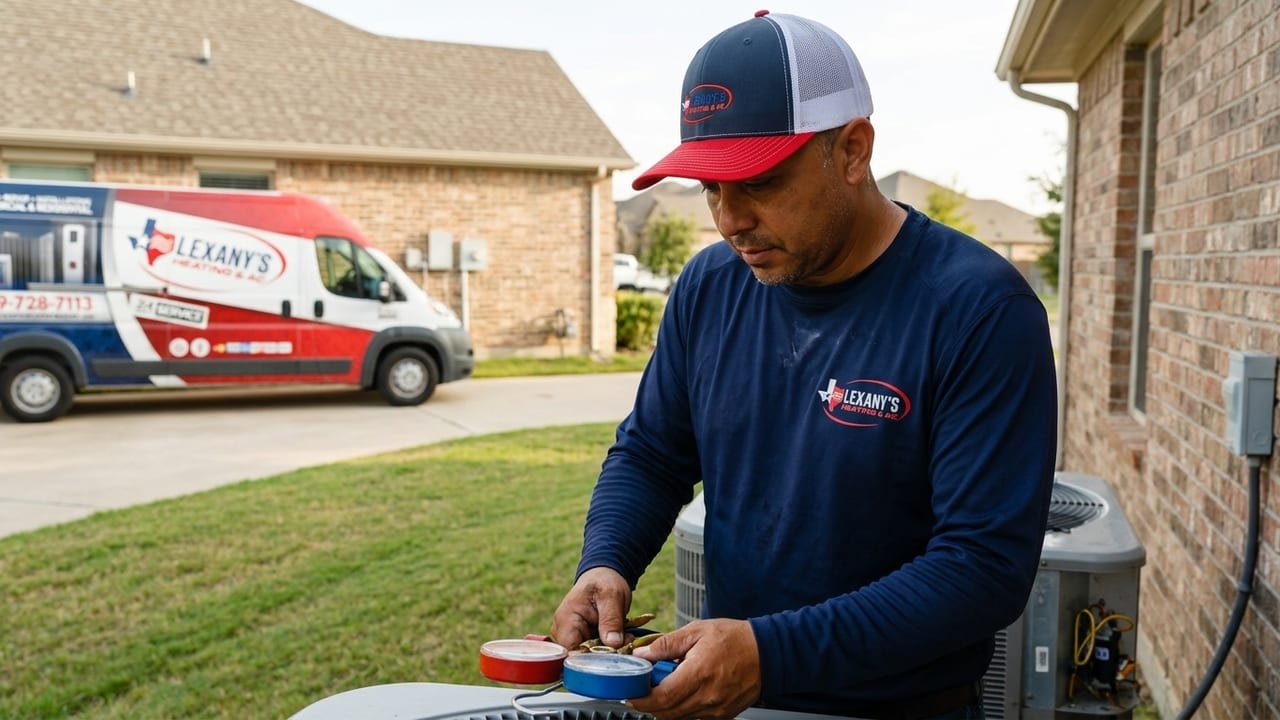
Hiring someone to work on your home’s heating and cooling system is a bigger decision than it sounds. The equipment is expensive, the work goes behind walls and in attics, and a bad installation can cost you thousands more down the road. This guide walks through the things that actually matter when you’re vetting a contractor — and the warning signs that should make you pause.
Start with the license
In Texas, anyone who installs, services, repairs, or maintains HVAC equipment for compensation is required to hold an Air Conditioning license issued by the Texas Department of Licensing and Regulation (TDLR). This is not optional, and it’s not just a formality — the license requires demonstrated knowledge of mechanical codes and refrigerant handling. Ask for the license number and look it up at the TDLR website before you book.
An unlicensed contractor who installs equipment may void your manufacturer warranty. If something goes wrong and there’s property damage, you may have limited legal recourse. The few minutes it takes to verify a license number is worth it every time.
Go to tdlr.texas.gov and search by contractor name or license number. You’re looking for a current, active A/C license. Lexany’s license is TX A/C #51447 — any reputable contractor should hand over their number without hesitation.
Certification and insurance
Beyond the state license, there are two more things worth checking:
- NATE certification. NATE (North American Technician Excellence) is an independent, exam-based credential for HVAC technicians. It isn’t required by law, but it signals that the tech has gone beyond the minimum. Ask whether any of the company’s technicians hold NATE certification.
- Liability insurance. Ask for a certificate of insurance before work begins. A contractor working in your home without liability coverage means you could be responsible for damage to your property or injuries that happen on the job. A legitimate shop carries it without being asked — but ask anyway.
Reading reviews honestly
Online reviews are genuinely useful, but they’re easy to misread. A few things to look for:
- Recency matters more than total count. A contractor with 50 reviews from the last year is more informative than one with 300 spread over a decade.
- Read the negative reviews, not just the positives. One or two negative reviews over hundreds is normal — see how the business responded. A pattern of complaints about pricing surprises, no-shows, or pushy upsells is a real signal.
- Look for specifics. Reviews that mention the owner’s name, describe the actual work done, or call out a specific crew member tend to be more reliable than generic five-star stamps.
- Google and Yelp together. Some contractors have suppressed or padded one platform but not both. A quick check on each takes two minutes.
Get the price in writing before any work starts
This is the single most common source of homeowner frustration in the HVAC trade. A verbal quote — even a detailed one — is hard to hold anyone to. What you want is a written, itemized estimate that breaks out the diagnostic fee, parts, and labor as separate line items. That way, if the scope changes or something unexpected comes up, you have a clear baseline.
On a repair call, the contractor should give you the written quote before any repair work begins. On a replacement or new installation, get the quote in writing before you sign anything or pay a deposit. If a contractor is reluctant to write it down, that’s a reason to slow down.
A trustworthy contractor will walk you through both options honestly, give you the cost of a repair alongside the cost of a replacement, and let you decide. If a contractor skips the repair option entirely and pushes straight to a new system — especially on a unit that isn’t that old — ask why. You’re entitled to a real answer.
Find out who actually shows up
This one surprises a lot of homeowners: the name on the truck and the person doing the work aren’t always the same. Some HVAC businesses act more like brokers — they book the job and hand it to subcontracted labor that isn’t directly employed or supervised by the licensed company. That’s not always a problem, but it’s worth knowing.
A good question to ask directly: “Is the person doing the work employed by your company, or do you use subcontractors for installation?” If it’s subcontractors, ask whether they’re licensed and how the company supervises the work. A company that’s proud of its crew will answer that question straightforwardly.
There’s also something to be said for owner-operated shops where the owner does the work himself, or at least stays involved in jobs personally. When your name is on the side of the truck, you tend to care a little more about getting it right. That isn’t a knock on larger companies — it’s just a different kind of accountability.
Red flags worth walking away from
A few patterns that should make you pause, regardless of price:
- High-pressure urgency. “You need to decide today or I can’t hold this price” is a sales tactic, not a service reality. HVAC equipment and parts are not that scarce. Take the time you need.
- Verbal-only quotes. Covered above — if it isn’t in writing, it isn’t a quote.
- No license or insurance provided when asked. A contractor who hedges or gets defensive when you ask for credentials has something to hide.
- Recommending a full replacement without diagnosing first. A straight recommendation to replace before running a proper diagnostic is a yellow flag. Age and condition matter, but so does the actual diagnosis.
- Door-to-door or unsolicited visits claiming your system “needs work” based on a quick outside look. These are almost always fishing expeditions.
- No physical address or inconsistent contact info. Fly-by-night operators often don’t have a real service address. Look for a consistent NAP (name, address, phone) across the web.
Questions to ask before you hire
Run through this list before you commit to any contractor — whether it’s a repair call or a full system replacement:
- What is your Texas A/C license number, and can I look it up? Any legitimate contractor hands this over immediately.
- Do you carry liability insurance? Can I see the certificate? You want this in hand before work begins — not promised verbally.
- Do any of your technicians hold NATE certification? Not required, but a good signal of investment in quality.
- Will you provide a written, itemized quote before any work starts? Parts and labor broken out separately.
- Who will actually be doing the work — an employee of your company, or a subcontractor? Know what you’re getting.
- Have you worked on this brand or system type before? Relevant for heat pumps, ductless systems, or older equipment.
- What happens if something goes wrong after the repair? Ask about a workmanship warranty — most reputable shops offer at least 30–90 days on labor.
- Can you walk me through both the repair and replacement option, with pricing for each? You should be the one making that call, not the contractor.
HVAC Contractor FAQs
How do I verify a Texas HVAC contractor’s license?
Texas requires an Air Conditioning license from the Texas Department of Licensing and Regulation (TDLR). You can look up any license number at the TDLR website — it’s free and takes about 30 seconds. Enter the contractor’s name or license number and confirm it’s current and in good standing. Lexany’s license is TX A/C #51447.
What is NATE certification and does it matter?
NATE (North American Technician Excellence) is the most widely recognized third-party certification for HVAC technicians in the US. It means the tech passed an exam on real-world installation and service knowledge — not just a manufacturer’s training course. It’s not a guarantee of great work, but it’s a meaningful credential to look for.
Should I get multiple quotes for HVAC work?
For a new system or major replacement, yes — getting two or three written quotes is smart. For a repair call, it’s less common and you’re mostly checking that the contractor gives you itemized written pricing before any work starts. The quote should break out the diagnostic fee, parts, and labor separately so there are no surprises.
Is it a problem if the owner doesn’t come out personally?
Not necessarily — a well-run shop can send a trained tech and do excellent work. What matters most is that whoever shows up is licensed, works for the licensed company (not a day-laborer subcontract), and is accountable. That said, for a small owner-operated business, having the owner on the job is a real signal of how much he cares about his reputation.

Owner of Lexany’s Heating & AC. Family-owned in Forney since 2011 — most days he’s the one on the truck doing the work himself. Bilingual (English/Spanish).