North Texas allergy season is no joke — and for a lot of Forney homeowners, the symptoms don’t stop at the front door. The same pollen, dust, dander, and mold spores that bother you outside collect and recirculate inside your home, often at higher concentrations than you’d expect. The encouraging part: your HVAC system is one of your best tools for cutting them down. Here’s how to do it well, with an honest take on what realistically helps.
The allergens hiding in a North Texas home
Before you fix anything, it helps to know what you’re actually fighting. Four allergens cause most indoor trouble around here, and they don’t all respond to the same solution:
- Pollen — tracked in on clothes, shoes, and pets, and pulled in through open windows and gaps. It spikes hard in a North Texas spring.
- Dust mites — microscopic, and they thrive in humid air and soft surfaces like bedding, carpet, and upholstery. Their waste is a major allergen.
- Pet dander — tiny skin flakes that stay airborne for a long time and settle into fabrics and ductwork.
- Mold spores — released by mold that grows wherever there’s persistent moisture: damp closets, around leaks, and on a cold, wet AC coil.
Notice the pattern: two of these — dust mites and mold — feed on humidity, while two of them — pollen and dander — are particles you filter out. That split is exactly why a single product never fixes everything, and why the steps below work in combination.
Get the filter right without choking airflow
Filtration is your front line against the particle allergens — pollen, dust, and dander. Every time your system runs, it pulls your home’s air through the filter, so the right one is quietly cleaning the air all day during a Forney summer.
Aim higher for allergies — but mind the airflow
MERV (Minimum Efficiency Reporting Value) measures how finely a filter catches particles. For allergy sufferers, MERV 11 to 13 captures a meaningful share of pollen and dander. But there’s a real catch: the denser the filter, the more it restricts airflow — and many home systems aren’t designed to push air through a MERV 13 one-inch filter. Force it and the system works harder, airflow drops, and air can even slip around a clogged filter’s edges.
The honest answer for allergy relief is often a whole-home air cleaner — a media cabinet or electronic unit with far more filtration surface — which delivers strong particle capture without strangling airflow. It’s usually a better allergy upgrade than just jamming a denser filter into a slot built for a basic one. Whichever route you take, change the filter on schedule; a clogged filter does the opposite of what you want.
Control humidity to starve dust mites and mold
Here’s the step allergy sufferers most often miss: dust mites need humidity above roughly 50 percent to thrive, and mold needs persistent moisture to grow and release spores. In a muggy Kaufman County summer, an under-dehumidified home is a comfortable habitat for both.
Keep your home in the 40 to 50 percent relative humidity range and you remove the conditions dust mites and mold depend on — which shrinks two of your four allergen sources at the root, not just at the filter. In practice that means making sure your AC runs long enough to actually dehumidify (an oversized unit that short-cycles cools without drying), and adding a whole-home dehumidifier if your home stays sticky on mild days or during peak humidity. A simple humidity gauge from the hardware store tells you where you stand.
Ducts, air cleaning, and UV
Beyond filtration and humidity, a few targeted options help in the right situation:
- Duct and vent cleaning — worth it when there’s a confirmed reason: visible mold inside the ducts, a rodent or insect issue, or heavy debris from a renovation recirculating through the home. If your filter is doing its job, routine duct cleaning usually isn’t necessary, and a better filter solves “dusty registers” for far less.
- Air cleaning and purification — a whole-home air purification system adds particle or contaminant capture beyond your filter, useful when someone in the home is especially sensitive.
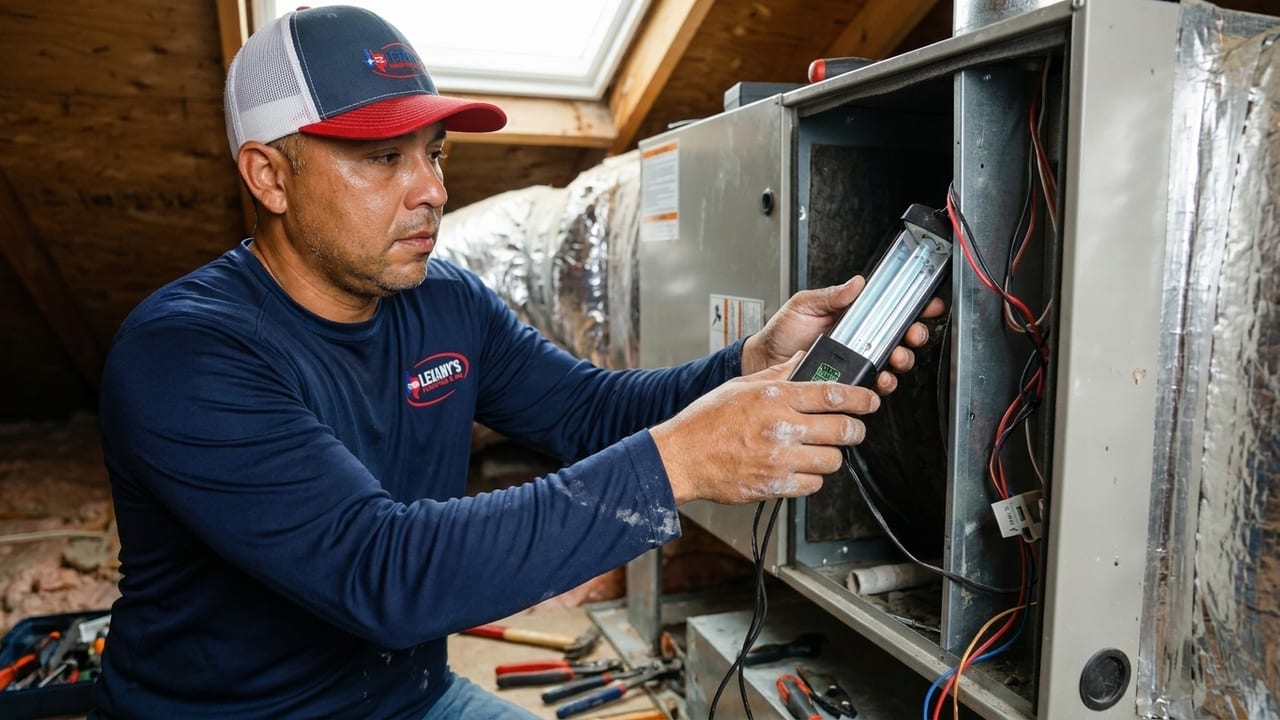
- UV light at the coil — a UV light keeps the cold, damp evaporator coil clean and slows the mold and biofilm that can grow there. It won’t trap pollen or dander (that’s the filter’s job), but it stops your own system from becoming a mold source. Honest framing: it solves a specific problem, not all of them.
Everyday habits that reduce allergens
Equipment does the heavy lifting, but daily habits cut the load it has to handle. None of these cost anything:
- Control allergens at the source — leave shoes at the door during pollen season, wash bedding weekly in hot water to knock back dust mites, and groom and bathe pets regularly to cut dander.
- Vacuum and dust smartly — a vacuum with a sealed HEPA filter keeps fine particles from blowing right back into the air, and damp-dusting traps allergens instead of scattering them.
- Use HVAC fan circulation in moderation — running the fan on its ‘circulate’ setting moves more of your home’s air through the filter; just be mindful that leaving it on ON all day can raise humidity in a Texas summer.
- Keep windows closed on high-pollen days — tempting on a nice spring morning, but it lets pollen pour in. Save the fresh-air flush for lower-count days.
No filter or purifier makes a home allergen-free — the honest goal is to meaningfully reduce what’s in your air, not eliminate it. Combine a good filter, controlled humidity, and a few habits and most allergy sufferers feel a genuine difference indoors. Anyone promising you zero allergens is overselling.
Allergen quick reference
A simple way to match each allergen to where it comes from and what actually helps:
If allergy season is rough inside your own home, the most reliable combination is the right filtration plus humidity control — and we’ll tell you honestly which pieces your home actually needs rather than selling the whole list. Give us a call at 469-728-7113; Gustavo and the team can usually take a look the same day, in English and Spanish. We hold a Texas A/C License #51447, are NATE certified, and serve Forney plus the nearby Kaufman County towns.
Allergen Reduction FAQs
What MERV filter is best for allergies without hurting my system?
For allergy sufferers, MERV 11 to 13 captures a meaningful share of pollen, fine dust, and dander. But going high carries a catch — a denser filter restricts airflow, and many residential systems aren’t built for MERV 13 with a standard one-inch filter. The better route for allergies is usually a whole-home air cleaner with more filtration surface, which gives you the capture without the airflow penalty. We can check your system’s specs and tell you what it can safely handle.
Does running the HVAC fan help with allergens?
It can, in moderation. Running the fan circulates air through the filter even when the system isn’t actively heating or cooling, so more of your home’s air gets cleaned. The trade-off in a humid Texas summer is that leaving the fan on ON can re-evaporate moisture off the cooling coil and raise indoor humidity. A good middle ground is the fan’s ‘circulate’ setting, or running it on AUTO and leaning on a quality filter. We can help you dial it in.
Can controlling humidity really reduce allergens?
Yes — it’s one of the most underrated steps. Dust mites need humidity above roughly 50 percent to thrive, and damp conditions feed mold, which releases allergenic spores. Keeping your home in the 40 to 50 percent range removes the conditions both depend on. In humid Kaufman County summers that often means making sure your AC runs long enough to dehumidify, or adding a whole-home dehumidifier. It won’t capture pollen, but it shrinks the dust-mite and mold problem at the source.
Will cleaning my ducts fix my allergies?
Sometimes, but not usually as a first step. Duct cleaning genuinely helps when there’s visible mold in the ducts, a rodent or insect problem, or heavy debris recirculating through the home. If none of that applies, allergy symptoms are more often solved by a better filter and humidity control — which address the ongoing source — than by a one-time cleaning that won’t stay clean without the upstream fix. We’ll look and give you a straight answer rather than selling a cleaning you don’t need.

Owner of Lexany’s Heating & AC. Family-owned in Forney since 2011 — most days he’s the one on the truck doing the work himself. Bilingual (English/Spanish).