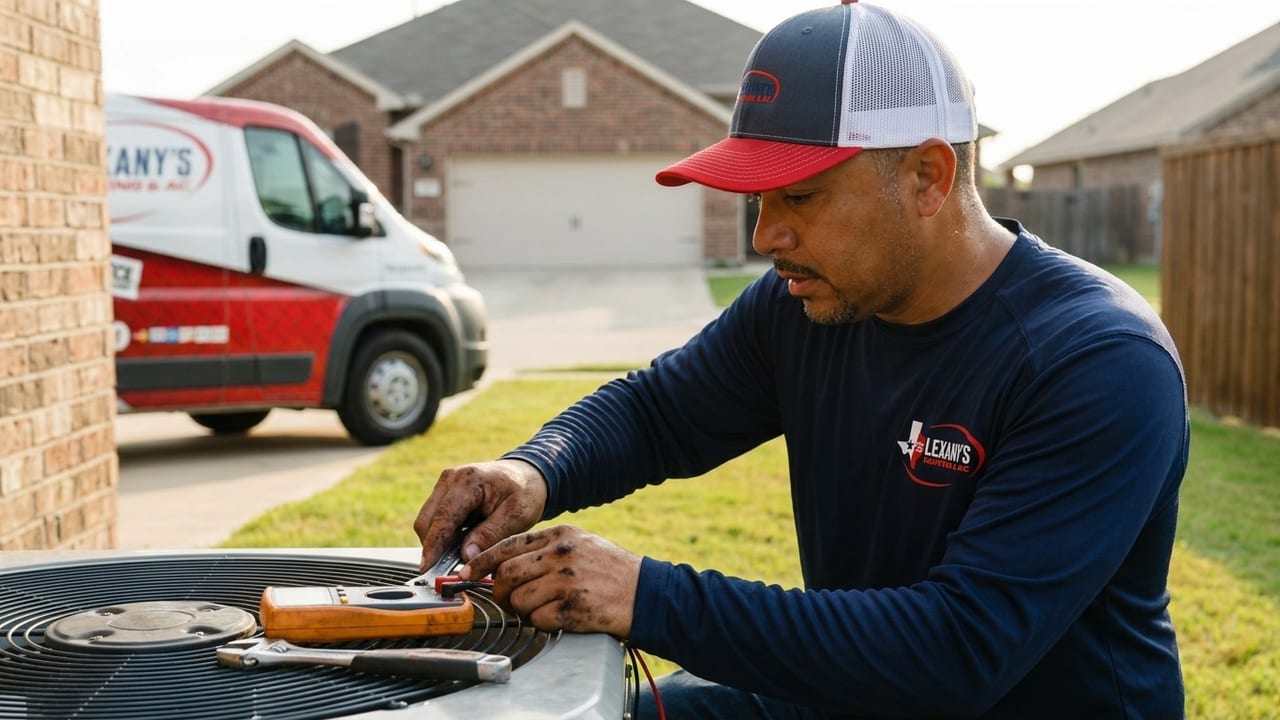
By the time a Forney summer is in full swing, your AC is running almost around the clock — and that’s the worst possible time to discover it’s not up to the job. The fix is simple: spend a little time in spring getting the system ready, while a problem is still a quick fix and not a 100-degree emergency. Here’s a checklist that takes the guesswork out of it.
Why spring is the time to prep your AC
Air conditioners almost never fail on a mild day. They fail on the hottest afternoon of the year, when they’ve been running flat-out for hours and the weakest part finally gives way. That’s not bad luck — it’s physics. The heat is what exposes a marginal capacitor, a slow refrigerant leak, or a coil that’s lost its airflow.
Spring is the window to catch all of that. Your system has been mostly idle through the North Texas winter, so any weakness is sitting there quietly, waiting. A check now turns a worn capacitor into a five-minute swap instead of a no-cool call on a Saturday in July. It also means you’re booked before the rush — when the first heat wave hits, everyone calls at once, and the schedule fills fast.
The week the first real heat wave hits, our phones don’t stop. Homeowners who booked a spring tune-up are the ones already taken care of. Getting on the schedule early is the single best thing you can do for a comfortable summer.
Your pre-summer readiness checklist
A few of these you can do yourself in an afternoon. The rest are quick for us. Run through the list and you’ll head into summer knowing your system is ready instead of hoping it is.
- Book a spring tune-up before the heat arrives. This is the one that prevents the most pain. We check the refrigerant charge, test the capacitor and electrical connections, clean the condenser coil, and confirm the system is ready to run hard. Schedule it in April or early May, before the rush.
- Change the air filter. A clean filter is small money for big protection. A clogged one chokes airflow, makes the system work harder, and can cause the coil to freeze up. Check it monthly through the summer and swap it when it looks dirty.
- Clear the outdoor condenser unit. Walk outside and look at the big outdoor unit. Clear away the leaves, grass clippings, and weeds that built up over winter, trim back any shrubs, and give it at least two feet of open space on all sides so it can shed heat properly.
- Test-run the system early. Don’t wait for the first 95-degree day to find out it doesn’t cool. On a warm spring afternoon, set the thermostat to cool a few degrees below room temperature and let it run for fifteen or twenty minutes. You should feel cold air at the vents and hear it cycle normally.
- Check the thermostat and its schedule. Replace the batteries if it uses them, confirm it’s reading the room temperature accurately, and if it’s programmable, set a summer schedule that eases off when no one’s home. A smart schedule cuts runtime without sacrificing comfort.
- Seal the obvious leaks. Weatherstrip around doors, caulk gaps around windows, and close off the spots where cooled air escapes and hot Texas air sneaks in. The less your home leaks, the less your AC has to fight all summer.
- Keep an eye on humidity. A home that feels cold but sticky is a sign the system isn’t pulling moisture out the way it should — often a sizing or airflow issue worth flagging. Comfortable indoor humidity makes the same temperature feel a lot more pleasant.
If your test run turns up warm air, weak airflow, or strange noises, don’t keep forcing it — running a struggling system in the heat can turn a small repair into a big one. Shut it down and give us a call so we can look before it gets worse.
Signs your system is already struggling
Sometimes the system tells you it’s not ready before summer even starts. If your spring test run — or those first warm days — turns up any of these, it’s worth a call now rather than later:
- Air from the vents that’s only mildly cool, or warm when it should be cold
- The system running much longer than it used to without reaching the setpoint
- Weak airflow even after a fresh filter
- Rooms that won’t keep up with the rest of the house
- Rattling, grinding, or a buzzing hum from the outdoor unit on startup
- An energy bill creeping up without a change in how you use the system
- A house that feels damp and clammy even when the temperature reads right
None of these get better on their own, and all of them get worse — and more expensive — once the system is running hard every day. Caught in spring, most are straightforward. You can find more detail on our AC repair and AC maintenance pages.
How to get on the schedule early
This is the easy part. Call us in spring, tell the office what’s going on or just that you’d like a seasonal tune-up before summer, and we’ll find a time that works. Because Gustavo does most of the work himself, you’re getting a real, careful look — not a rushed checklist someone races through to get to the next stop.
Getting checked early isn’t about selling you something you don’t need. It’s the difference between a comfortable summer and the sinking feeling of a dead AC on the hottest day of the year. We’d much rather catch the small stuff now.
If you’d like to head into summer with one less thing to worry about, give us a call and we’ll get you on the schedule — same-day service when you need it, and we work in English and Spanish. Reach Gustavo and the team at 469-728-7113. We’re a residential contractor holding a Texas A/C License #51447, serving Forney and nearby Kaufman County towns like Mesquite, Terrell, Kaufman, Heartland, Rockwall, and Heath.
Summer AC Prep FAQs
When should I get my AC checked before summer in Forney?
Spring — ideally April or early May, before the first stretch of triple-digit days. That’s when the system has been mostly idle over winter and any problem that developed is still hiding. Getting it looked at before the heat arrives means a small fix instead of an emergency call, and it means you’re on the schedule before everyone else’s system fails at the same time.
How often should I change my AC filter in the summer?
For most Forney homes, check it every month during peak cooling season and change it when it looks dirty — usually every one to three months depending on the filter type, pets, and dust. A clogged filter chokes airflow, makes the system work harder, and is one of the most common reasons an AC underperforms or freezes up in the heat.
Can I just run my AC harder when it gets hot instead of prepping it?
You can, but it’s the expensive way to find out something’s wrong. A system with a weak capacitor, low refrigerant, or a dirty coil might limp along on mild days and then fail on the worst afternoon of the year — exactly when we’re busiest and you’re most uncomfortable. A quick spring check catches those weak points before the heat exposes them.
What does a spring AC tune-up actually include?
A real tune-up is more than a quick look. We check the refrigerant charge, test the capacitor and electrical connections, clean the condenser coil, inspect the blower and drain line, verify airflow, and confirm the thermostat is reading and cycling correctly. The goal is to find the small stuff now and make sure the system is ready to run hard all summer.

Owner of Lexany’s Heating & AC. Family-owned in Forney since 2011 — most days he’s the one on the truck doing the work himself. Bilingual (English/Spanish).