Cleaner indoor air is one of those home-improvement goals where the marketing noise far outruns the reality. There’s no single product that fixes everything — but there is a straightforward set of layers, each one doing a specific job, that adds up to genuinely healthier air in your Forney home. Here’s how each piece fits, what it handles, and what it doesn’t.
Why clean air needs layers, not one fix
Indoor air has several distinct problems: particles you breathe (dust, pollen, dander), biology that grows on damp surfaces inside your equipment (mold, biofilm), excess moisture that makes summer air muggy and encourages that same mold, stale air from a house sealed too tight, and accumulated grime inside old ductwork. No single product handles all of that. A UV light won’t fix humidity. A dehumidifier won’t catch pollen. A clean filter won’t disinfect the coil.
The good news: each problem has a well-matched fix, and you don’t have to do all of them at once. Start where it matters most — usually filtration — and add layers where your home has a real issue.
Start here: filtration
Filtration is the foundation. Your HVAC system pulls air through a filter every time it runs, which — in a Texas summer — can be most of the day. A good filter is quietly catching the particles you actually breathe: dust, pollen, pet dander, mold spores. A thin fiberglass filter barely does the job.
MERV ratings in plain terms
MERV (Minimum Efficiency Reporting Value) measures how finely a filter catches particles. Higher is more effective, but not always better for your system:
- MERV 1–4 — basic fiberglass; catches large dust only. Not enough for most homes.
- MERV 8–11 — the practical sweet spot for most residential systems; catches fine dust, pollen, and dander without strangling airflow.
- MERV 13+ — hospital-grade; very effective but can restrict airflow in systems not designed for it, causing the system to work harder and potentially strain the blower.
The right MERV for your home depends on your system’s specs — it isn’t a one-size number. If you have pets, allergies, or someone sensitive to particles at home, a whole-home air cleaner (a media cabinet or electronic unit mounted on the system) is often a better upgrade than simply going higher-MERV with a standard filter, because it provides more filtration surface without the airflow penalty.
A clogged filter restricts airflow, which stresses your system and ironically lets more particles bypass the edges. In a Forney summer — when the AC runs long hours — a standard filter can clog faster than you expect. Check it monthly and replace it on schedule.
Humidity — the Texas factor
Texas heat means humidity. In a Kaufman County summer, the air inside an under-dehumidified home doesn’t just feel sticky — it actively feeds mold and dust mites, two of the biggest indoor-air quality problems. Your air conditioner does dehumidify as it cools, but an oversized system that short-cycles (runs briefly, then shuts off) doesn’t run long enough to pull real moisture out of the air.
If your home feels muggy even when the AC is running, or if you see condensation on windows or musty smells in closets, humidity is your issue — not filtration. Solutions:
- Correctly sized AC — bigger is not better. An oversized unit short-cycles and leaves air humid. Sizing matters more than brand.
- Whole-home dehumidifier — a dedicated unit mounted on the air handler or in the ductwork handles moisture independently of the AC’s cooling cycle, which is especially useful during mild spring days when you’re not running the AC heavily but indoor humidity climbs.
- Two-stage or variable-speed equipment — runs at lower capacity for longer, which means more time dehumidifying. Noticeably more comfortable in a humid climate.
UV at the coil
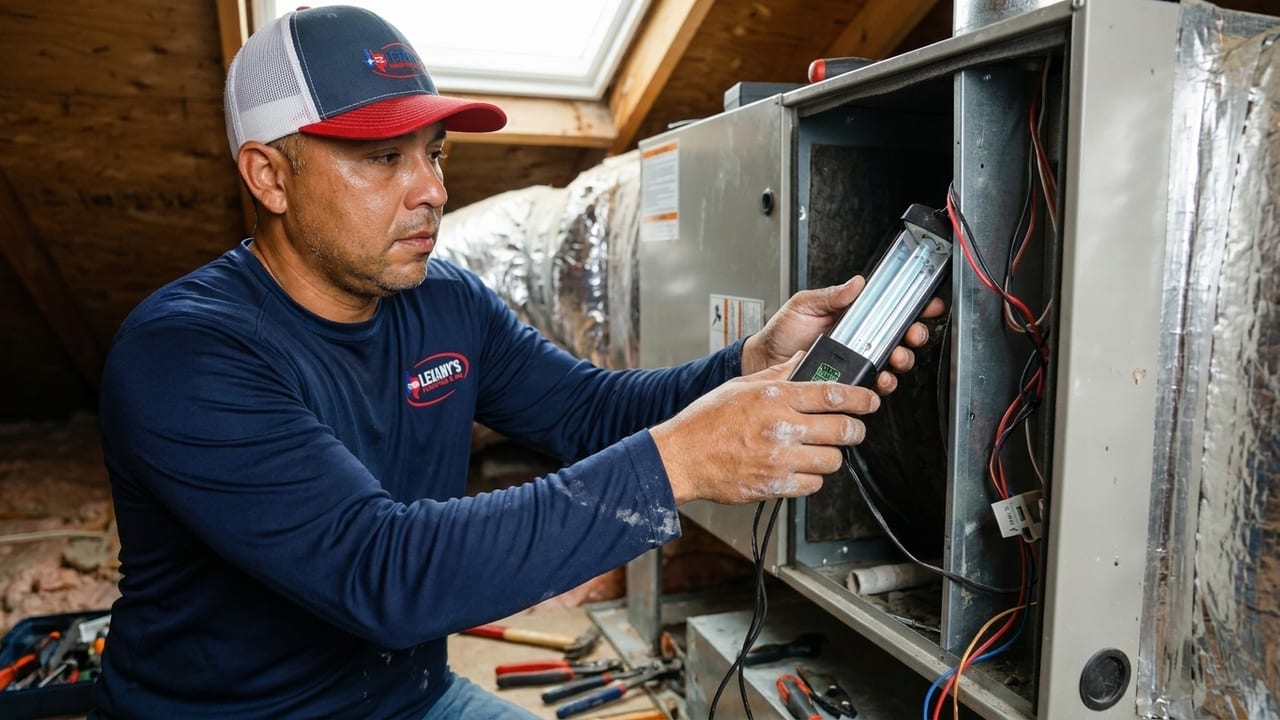
Your indoor evaporator coil is cold and wet whenever the AC runs — ideal conditions for mold and biofilm. A UV lamp installed at the coil shines on it continuously, keeping those surfaces clean, preventing the musty smell that comes from a mold-covered coil, and helping the system maintain its rated airflow and efficiency.
UV is genuinely useful, but it’s worth being honest about what it does and doesn’t do. It’s a surface treatment — it shines on the coil, not on every cubic foot of air passing through. It won’t capture dust or pollen (that’s filtration), and it won’t dry out humid air (that’s humidity control). Think of it as keeping your system clean so everything else works better. As part of a plan that already includes good filtration and humidity management, a UV light at the coil is a sensible upgrade — especially if you’ve had musty-smell problems in the past.
Fresh-air ventilation
Modern homes are built tighter than older ones — which is great for energy bills but means stale air builds up unless you actively bring in fresh air. Cooking, cleaning products, off-gassing from new materials, and just normal occupancy can raise indoor CO2 and volatile organic compound (VOC) levels noticeably in a well-sealed house.
Solutions range from simple to systematic:
- Opening windows — free, and genuinely effective for an occasional flush, though not practical all day in a Forney July.
- Exhaust fans — kitchen and bath fans that vent outside (not just recirculate) remove moisture and pollutants at the source.
- Energy recovery ventilators (ERVs) — a ducted system that continuously exchanges stale indoor air for fresh outdoor air while recovering most of the conditioned energy in the process. Best option for tight newer homes where ventilation is a persistent issue.
Fresh air brought in by an ERV passes through your filtration system, so the two upgrades reinforce each other. If you’re adding an ERV, it’s also a good moment to confirm your filter setup is doing its job — the two make a strong combination.
Duct cleaning: when it’s worth it
Duct cleaning is one of the most widely marketed — and most widely oversold — HVAC services. The honest position: for most homes with reasonable filtration, duct cleaning is not a routine necessity. Ducts don’t accumulate dramatic amounts of debris when the filter upstream is doing its job.
Genuine reasons to consider duct cleaning:
- Visible mold growth inside the ducts or on registers
- A confirmed rodent or insect infestation in the ductwork
- A major renovation where drywall dust and construction debris entered the system
- You bought a home with no maintenance history and genuinely have no idea what’s in there
If you’re getting dusty registers or allergy symptoms but none of the above applies, a better filter is almost always the correct first move. It’s the smaller spend, and it addresses the ongoing source rather than a one-time cleaning that won’t stay clean without the upstream fix anyway.
Putting it all together
The layers build on each other in a natural order:
Most Forney homes benefit from starting with a filtration upgrade and — if humid air is an issue, which it often is — addressing humidity. UV at the coil is a sensible next layer, especially in older equipment that has a history of musty smells. Ventilation and duct cleaning apply to specific situations rather than every home.
We’ll look at your system and tell you honestly which step will actually make a difference — usually same day, often Gustavo himself. No upselling the whole list when your home only needs one piece of it.
Clean-Air FAQs
What’s the single most important thing I can do for my home’s air quality?
Start with filtration — the right filter for your system is the foundation everything else builds on. It catches the particles you actually breathe every day: dust, pollen, pet dander. Get that right first, then layer in humidity control or UV if your home has specific issues.
What MERV rating filter should I use?
For most homes, MERV 8–11 is a practical sweet spot — it captures fine particles without restricting airflow to the point where your system works harder. Very high MERV filters (13+) can choke the airflow in systems not designed for them. If you’re unsure, we can check your system’s specs during a seasonal tune-up.
Does a UV light replace a good filter?
No — they handle completely different problems. A UV light keeps the indoor coil clean and slows mold and biofilm growth on damp surfaces. It doesn’t trap particles. You still need a good filter for dust, pollen, and dander. The two work best together: the filter catches what you breathe, the UV keeps the system clean.
How do I know if my ducts actually need cleaning?
Genuine warning signs: visible mold inside the ducts, a rodent or insect infestation, or so much debris that it’s visibly blowing out of registers. Dusty air and allergy symptoms alone don’t mean dirty ducts — often a better filter solves that. We’ll check and give you a straight answer.

Owner of Lexany’s Heating & AC. Family-owned in Forney since 2011 — most days he’s the one on the truck doing the work himself. Bilingual (English/Spanish).