Improving your home’s air doesn’t have to mean buying every gadget on the shelf. A handful of practical, mostly-affordable steps — done in the right order — make a real difference, and a few of them cost almost nothing. Here are five we’d recommend to any Forney homeowner, with an honest note on what each one does and doesn’t do.
Why indoor air is worth your attention
It’s easy to assume the air inside your home is cleaner than the air outside. In reality, it often isn’t. As a general point, the EPA has noted that indoor air can carry higher concentrations of some pollutants than outdoor air — because homes trap dust, pollen tracked in from outside, cooking byproducts, off-gassing from furnishings, and the moisture that feeds mold. That’s general knowledge rather than a measurement of your particular home, but it’s a fair reason to take the air inside seriously, especially if anyone in the house has allergies or asthma.
The good news: you don’t have to tackle everything at once or spend a fortune. These five steps cover the bases, and you can layer them in as your home needs them.
Five practical ways to improve your air
In rough order of bang-for-the-buck, here’s where to put your effort:
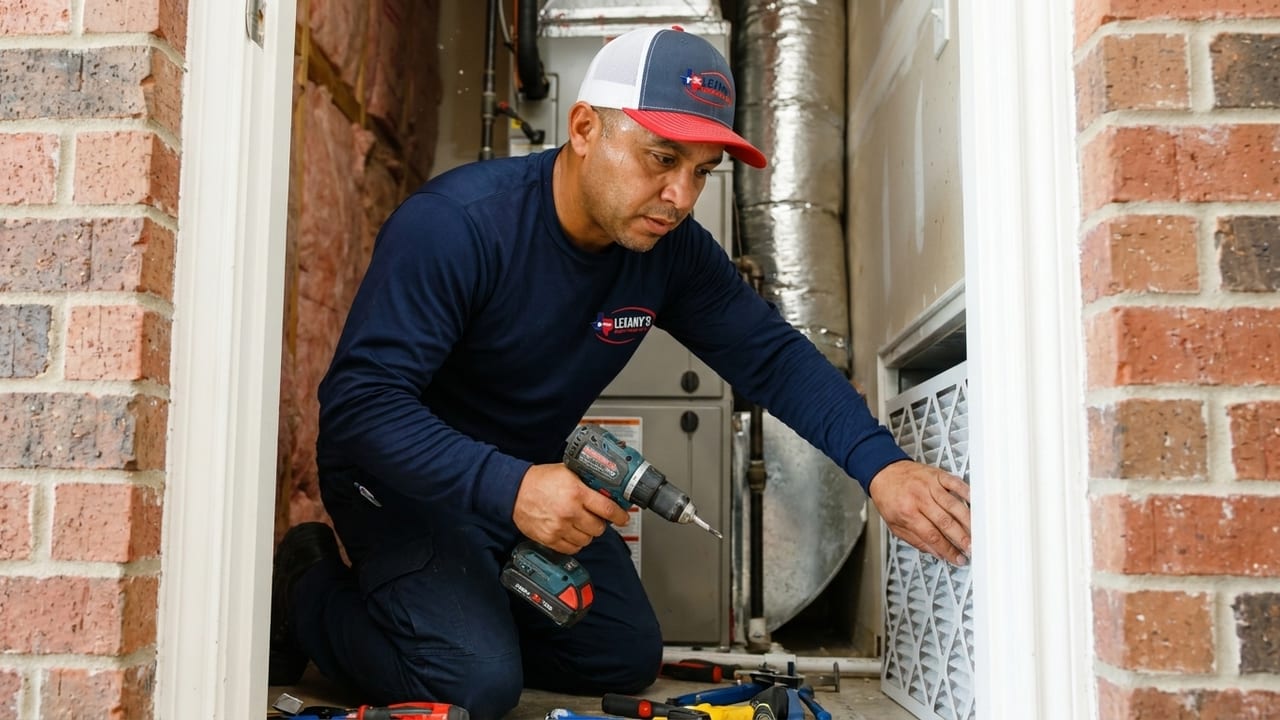
- Use the right filter — and change it on schedule. This is the foundation. Your HVAC system pulls air through the filter every time it runs, so a good filter quietly catches the dust, pollen, and pet dander you actually breathe. The key is matching the filter to your system: MERV 8 to 11 is the practical sweet spot for most homes — fine enough to catch real particles, not so dense it strangles airflow. Then replace it on schedule (monthly during heavy-use Texas summers) before it clogs. A clogged filter restricts airflow, stresses your system, and lets particles slip around the edges. This step costs a few dollars and does more than any single upgrade.
- Control your indoor humidity. In a humid Kaufman County climate, moisture is half the air-quality battle. Air that sits above roughly 50 to 55 percent relative humidity feels muggy and actively feeds two of the biggest indoor problems — mold and dust mites. Keeping your home in the 40 to 50 percent range with a correctly sized, longer-running AC or a whole-home dehumidifier cuts both. What it does: removes the conditions mold and mites need. What it doesn’t: it won’t capture particles, so you still need that filter.
- Have your ducts and vents cleaned when there’s a real reason. Duct and vent cleaning is genuinely worth it when there’s a confirmed problem — visible mold inside the ducts, a rodent or insect issue, or heavy debris left over from a renovation. In those cases it removes a real source of contamination that recirculates through every room. Be honest with yourself, though: if your filter is doing its job, routine duct cleaning usually isn’t necessary, and a better filter often solves “dusty registers” more cheaply than a one-time cleaning.
- Add air cleaning or UV where it actually helps. If a good filter and humidity control aren’t enough — say someone in the home is particularly sensitive to particles — a whole-home air cleaner or purification system adds filtration surface and capture beyond a standard filter. Separately, a UV light installed at the coil keeps that cold, damp surface clean and slows mold and biofilm growth. They solve different problems: air cleaning targets what you breathe, UV keeps the system itself clean. Most homes need one or the other, not the whole catalog. You can read more on our air purification page and UV light page.
- Improve ventilation and control pollutants at the source. Modern homes are sealed tighter than older ones, which is great for energy bills but lets stale air build up. Use your kitchen and bath exhaust fans (the kind that vent outside, not just recirculate) to remove moisture and cooking byproducts where they’re created. Open windows for an occasional flush on a mild spring or fall day. And cut pollutants at the source where you can — proper storage of cleaning chemicals, fewer heavily scented products, keeping shoes and outdoor allergens at the door. This is the cheapest layer of all.
The number-one reason home air quality slips is simple: the filter gets forgotten until it’s gray and clogged. A recurring monthly reminder during cooling season — and writing the date on the filter edge with a marker — keeps the most important step on track without thinking about it.
Where most Forney homes should start
If you only do one thing this week, fix your filter — the right type, changed on schedule. If your home also feels muggy or you’ve smelled musty closets, humidity is your next layer, which matters more in a humid Kaufman County summer than most homeowners realize. Air cleaning, UV, and duct cleaning are situation-specific: useful when your home has the matching problem, and not worth the money when it doesn’t.
The honest part is knowing which of these your home actually needs rather than buying the whole list. That’s where it helps to have someone look at the system itself, measure what’s really going on, and recommend only the pieces that will make a difference for your particular home — which is exactly how we’d rather work than reaching for the upsell.
These layers build on each other, and most homes only need two or three of them. Start with filtration, address humidity if it’s an issue, and add the rest only where there’s a real reason. Anyone telling you a single home needs the entire list is selling, not solving.
Want a straight answer on which of these would help your home most? Give us a call at 469-728-7113 — Gustavo and the team can usually take a look the same day, and we work in English and Spanish. We hold a Texas A/C License #51447, are NATE certified, and serve Forney plus the nearby Kaufman County towns. You can also see the full range of what we offer on our indoor air quality page.
Indoor Air Quality FAQs
What’s the cheapest thing I can do to improve my home’s air quality?
Change your air filter on schedule and make sure it’s the right type for your system. It’s the single most affordable step and the foundation everything else builds on, because your HVAC pulls air through that filter every time it runs. A clean, properly chosen filter catches the dust, pollen, and dander you breathe every day — and it costs a few dollars.
Is a higher-MERV filter always better for cleaner air?
No. A higher MERV number catches finer particles, but go too high for your system and the filter restricts airflow — your equipment works harder, and air can even slip around the edges of a clogged filter. For most homes MERV 8 to 11 is the practical sweet spot. If you want more filtration without the airflow penalty, a whole-home air cleaner with more surface area is usually a better move than simply going to a denser standard filter. We can check your system’s specs first.
Does indoor air really get more polluted than outdoor air?
It often can. As a general point, the EPA notes that indoor air can carry higher concentrations of some pollutants than the air outside — because homes trap dust, cooking byproducts, off-gassing from materials, and moisture that feeds mold. That’s general guidance, not a measurement of your specific home, but it’s a fair reason to take indoor air seriously rather than assuming inside is automatically cleaner.
Do air purifiers and UV lights do the same thing?
No — they handle different problems, and that’s worth being clear about. Air cleaning and purification add a layer of particle or contaminant capture beyond your filter. A UV light installed at the coil keeps that cold, damp surface clean and slows mold and biofilm growth — it doesn’t trap particles. Often the most honest answer is that a home needs one or the other, not both. We’ll tell you which actually fits your situation.

Owner of Lexany’s Heating & AC. Family-owned in Forney since 2011 — most days he’s the one on the truck doing the work himself. Bilingual (English/Spanish).