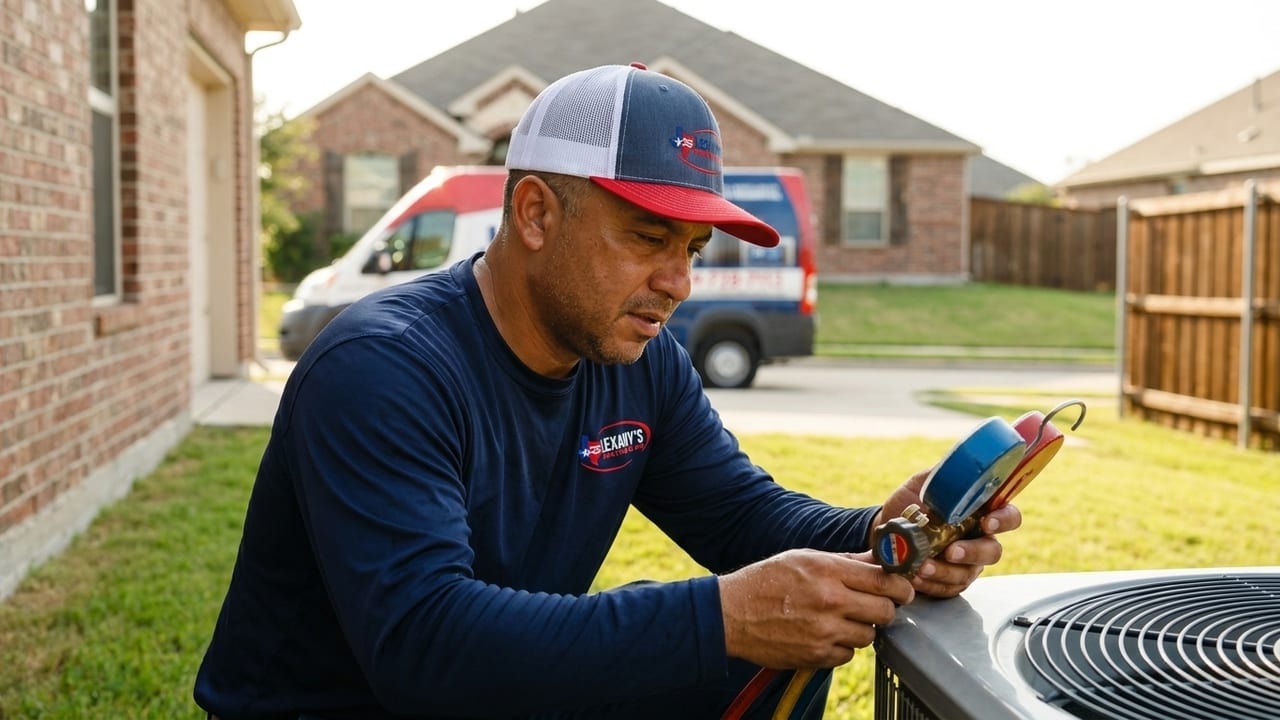
North Texas asks two different things of your HVAC system. From roughly May through September, the house fights a long, relentless cooling season — the kind where the system runs for hours and the power bill shows it. Then a short, sharp winter arrives, sometimes dropping to the mid-20s for a few nights before bouncing back to the 60s. Getting a Forney home efficient means solving for both, in the right order.
Two very different asks on one system
Most efficiency advice is written for climates with long, hard winters. Forney is the opposite — the cooling season is the dominant load, and winter is brief. That changes the math. Improvements that pay back quickly in a cold northern climate might take years here, and a few things that don’t get much attention nationally matter a lot in a hot-humid Texas summer. The good news: the foundation that keeps your home efficient in summer is exactly the same one that keeps it efficient in winter. Fix it once and both seasons benefit.
The foundation: right-sizing and sealed ducts
Before anything else — before new equipment, before smart controls, before anything that costs real money — the foundation has to be right. That means two things.
Right-sizing
A system that’s too large for the home short-cycles. It blasts on, hits the thermostat setpoint quickly, and shuts off — before it has time to pull humidity out of the air. In a Texas summer, humidity is half the discomfort problem. A correctly sized system runs longer, steadier cycles that actually wring moisture out. It’s also quieter, easier on the equipment, and runs more efficiently over time. An oversized unit is a common legacy of older installations and “bigger is safer” guesses — a proper load calculation tells you what the home actually needs.
Sealed ductwork
The duct system is how conditioned air gets from the equipment to the rooms you’re paying to cool or heat. On many homes — especially those built before the last decade or so — the ducts leak significantly into the attic or crawlspace. That means you’re paying to cool the attic. Sealing the ducts is often the highest-return single fix available: it cuts the energy wasted before it even reaches your living space, and it noticeably improves airflow and evenness across rooms.
A high-efficiency system pushing air through leaky ducts is still losing a big share of what you paid for. Seal the ducts first — then whatever equipment you have (or buy) reaches more of its rated potential.
Keeping equipment at rated efficiency
When a system is new and clean, it runs at the efficiency number on the box. Over time — dirty coils, a slightly low refrigerant charge, a clogged filter — that number quietly degrades. The system works harder, runs longer, and costs more to do the same job.
Spring tune-up (before cooling season)
A spring tune-up cleans the evaporator and condenser coils, checks the refrigerant charge, confirms airflow, and verifies that the system is ready to run for months under heavy load. In a Forney summer, the AC is your most-used appliance — it earns a real inspection before it starts that stretch.
Fall tune-up (before heating season)
The fall visit focuses on the heating side: heat strips, furnace burners (if applicable), heat exchanger integrity, and the controls that switch the system over from cooling. Our winters are short but they arrive fast — a first hard freeze without a working heater is an expensive emergency. A quick fall tune-up keeps that from being a surprise.
Filters
A clogged filter restricts airflow and forces the system to work harder for every degree of cooling or heating. The right change interval depends on the filter type and how dusty the home is — but checking it every month during the heavy cooling season takes two minutes and keeps the system breathing freely.
A heat pump as a dual-season efficiency play
If the equipment is aging and a replacement is on the horizon, a heat pump is worth a serious look in our climate — specifically because of the two-seasons problem this post is about.
A heat pump doesn’t burn fuel to make heat. It moves heat — out of the house in summer (just like a regular AC) and into the house in winter by extracting heat from the outdoor air. That “moving heat instead of making it” property is what makes it efficient: in mild-winter conditions, it can deliver noticeably more warmth per unit of electricity than an electric resistance heater would. Forney winters — mostly in the 30s and 40s, with occasional dips below freezing — are close to ideal for a heat pump. The long cooling season it handles exactly like an AC. The short winter it handles efficiently without a separate furnace. One system, both seasons, one thing to maintain. For homes without existing gas lines, it often becomes the practical default. For homes with gas, a dual-fuel setup — heat pump for mild days, gas furnace for the rare hard freeze — combines both advantages.
Cooling season vs. heating season — what helps each
Smart-thermostat habits that actually help
A smart thermostat can reduce what you spend on HVAC — but most of the savings come from two habits, not from any particular feature. First: don’t cool or heat the house when no one is home. A schedule or occupancy detection that backs the temperature off during empty hours pays back quickly in a hot Forney summer. Second: hold a steady setpoint instead of cranking the thermostat down to 68°F to “cool it faster.” The system cools at the same rate regardless of where you set it — a lower setpoint just means it runs longer, not faster.
Beyond those two, the value is modest. Geofencing, humidity tracking, and remote access are genuinely useful; they just don’t move the bill the way tight ducts and right-sizing do. Treat a smart thermostat as a helpful layer on top of a solid foundation — not as a substitute for one.
A seasonal tune-up and a duct inspection will do more for most Forney homes than a new thermostat will. We’d rather tell you that than sell you something you don’t need. When the equipment is genuinely aging, we’ll tell you that too — and give you honest numbers before you decide.
Tightening the house itself
The HVAC system removes heat. But how fast heat enters the home in summer — and leaves it in winter — is mostly decided by the house, not the equipment. Shade on west- and south-facing windows cuts the afternoon heat load significantly in a Texas summer. Weatherstripping around doors and windows keeps conditioned air in and outdoor air out. Attic ventilation that exhausts heat before it bakes down into the living space reduces how hard the system has to work. None of this replaces a well-maintained system, but a tight house means the system you have runs less to do the same job — and whatever you upgrade to will run less too.
The order matters. Get the foundation right — sizing, ducts, tune-ups. Layer in smart controls. And keep the house itself from undermining the system. When you’re ready to talk through what’s most worth doing for your home, most conversations start the same day. Usually with Gustavo himself — TX A/C #51447, NATE certified, and the person who’ll actually do the work.
Energy-Efficiency FAQs
Why does my AC seem to run constantly in a Forney summer?
Usually one of three reasons: the system is undersized for the home, the ducts are leaking conditioned air into the attic before it reaches the rooms, or the house itself is letting heat pour in faster than the system can remove it. A seasonal tune-up and a duct check can isolate which it is — often it’s a combination.
Do I really need two separate tune-ups a year?
In North Texas, yes. A spring tune-up preps the AC for our long cooling season — checking refrigerant, cleaning coils, and confirming airflow. A fall tune-up does the same for the heating side before the first cold front. Each season puts different stress on the system, so a single annual visit often misses one half of the picture.
Is a heat pump worth it if Forney winters are mild?
Mild winters are actually the strongest argument for a heat pump. It moves heat instead of burning fuel, which makes it very efficient when outdoor temperatures stay above freezing most of the time — exactly our climate. You also get one system handling both cooling and heating instead of two separate units to maintain.
Will a smart thermostat meaningfully lower my bill?
It helps, but it’s a supporting player, not the main fix. A smart thermostat saves money by not cooling an empty house and by holding steadier setpoints. Those savings are real and easy to get — just keep them in perspective against the bigger wins from tight ducts and a right-sized, well-maintained system.

Owner of Lexany’s Heating & AC. Family-owned in Forney since 2011 — most days he’s the one on the truck doing the work himself. Bilingual (English/Spanish).