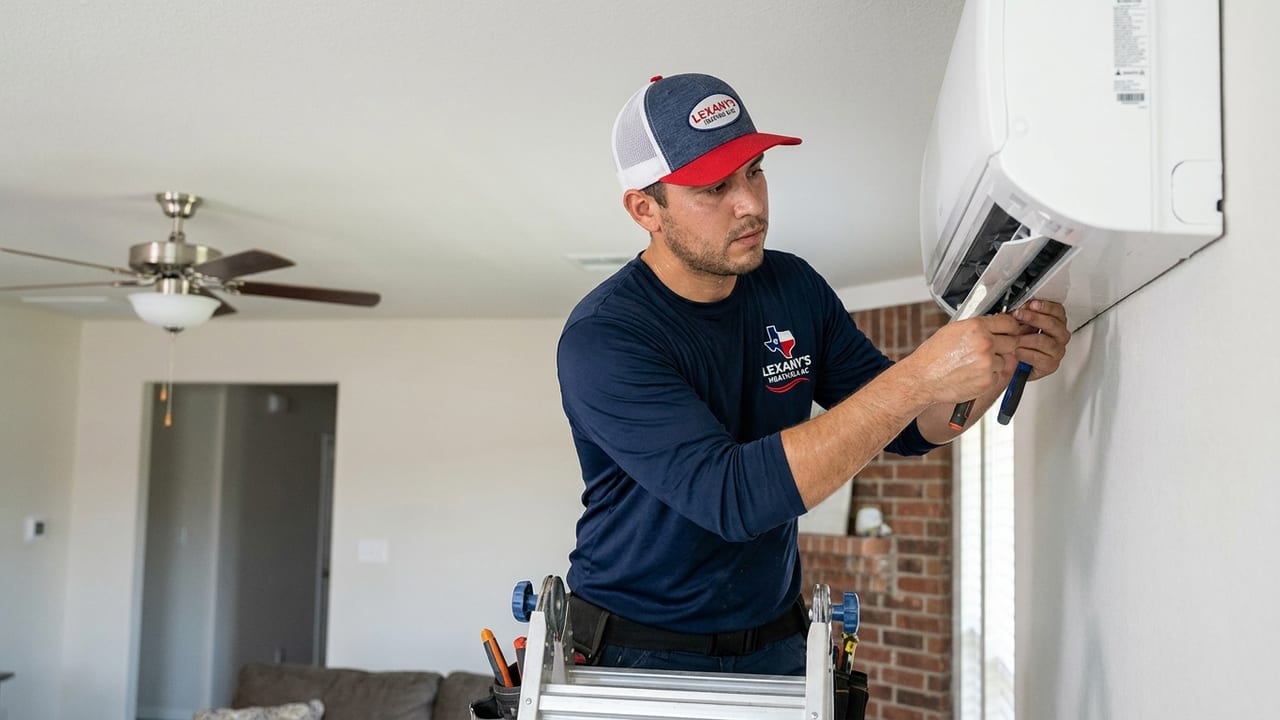
Most homeowners think of HVAC as a collection of separate appliances — the AC unit out back, the furnace in the closet, maybe an air purifier plugged into a bedroom. In practice, those pieces share the same ductwork, the same airflow, and the same handful of weak points. When one piece is mismatched, poorly sized, or serviced in isolation, the others quietly pay for it. Here is how the three pillars of home comfort — cooling, heating, and indoor air quality — actually connect, and why treating them as one system makes a real difference.
Your home’s comfort is one connected system
Picture what happens on a hot July afternoon in Forney. The AC runs, pulling warm air through the return duct, cooling it across the evaporator coil, and pushing it back through the supply registers. That same duct system is what the furnace uses in January. The same blower motor moves the air regardless of the season. And every cubic foot of conditioned air that moves through those ducts picks up whatever is in them — dust, humidity, mold spores, dander — before it reaches the rooms where your family sleeps and eats.
That shared infrastructure is the reason a leaky duct hurts your AC bill in summer and your heating bill in winter. It is why an oversized furnace that short-cycles also leaves the air humid in spring. It is why a clogged filter stresses the blower on every call the system makes. The equipment is separate; the delivery system is one.
Pillar 1 — Cooling
In a North Texas home, the cooling system does the most work of the three pillars. Forney summers run hot from late May through September, and the AC is the reason a well-built house stays livable when it is 100°F outside.
What it covers
- Removing heat from the indoor air (the condenser outside dumps it outside)
- Removing a significant share of indoor humidity as a byproduct of cooling the coil
- Moving conditioned air through the duct system to every room
The most common cooling problems — a room that never gets cool, a system that runs constantly, high humidity even when the temperature is fine — almost always trace back to three things: equipment that is sized wrong for the house, ductwork that leaks or is poorly balanced, or a refrigerant charge that has drifted. A real load calculation, clean ductwork, and a seasonal tune-up address all three before they become expensive.
Pillar 2 — Heating
Our Forney winters are short but real. Most of the heating season is mild — nights in the 30s and 40s — with a handful of hard-freeze events that test whatever equipment is in the house. The heating system shares almost everything with the cooling side: the same ductwork, the same blower, the same filter. Only the heat source is different.
What it covers
- A gas furnace burns natural gas; the blower pushes warm air through the same ducts the AC uses
- A heat pump runs the refrigeration cycle in reverse, pulling heat from outdoor air and delivering it inside — and then cools the house the same way an AC does all summer
- Electric backup heat steps in on the coldest nights when a heat pump’s efficiency tapers
Because the ducts are shared, a furnace or heat pump that is not matched to the rest of the system can undermine the cooling side without anyone realizing it. An oversized furnace heats the house too fast, the blower shuts off before the air distributes evenly, and the ductwork that looked fine in summer develops hot spots in January. Sizing and matching matter in both directions.
Whatever affects the ductwork affects both the heating and cooling sides. A duct that leaks conditioned air into the attic costs you money in July on your electric bill and again in January on your gas bill. Fix it once and both seasons improve.
Pillar 3 — Indoor air quality
Indoor air quality — filtration, humidity control, and fresh-air ventilation — is the pillar most homeowners think about last, usually after something goes wrong. In a tight modern home, the air inside can carry more particulates, humidity, and stale air than the air outside if the system is not managing it. And all of that rides on the same ductwork as the cooling and heating.
What it covers
- Filtration — standard 1-inch filters catch large particles; higher-MERV or media filters capture finer dust, allergens, and dander. The right filter depends on the blower’s capacity — too restrictive a filter starves the airflow and stresses the system
- Humidity control — in a Forney summer, the AC removes a lot of humidity, but on mild days when the system runs less, a whole-home dehumidifier keeps the air from feeling heavy; in winter, forced-air heating can dry the air out and a humidifier rebalances it
- UV lights and air purifiers — mounted in the air handler, they treat the air at the coil before it recirculates; worth considering in homes with allergy or asthma concerns
- Duct cleaning and ventilation — ducts that have not been cleaned in years can redistribute debris through every room every time the system runs
IAQ upgrades almost never require new equipment — they integrate with what you already have. But they do need to be matched to the existing system. A media cabinet filter that restricts airflow on an older blower can cause more problems than it solves. That is a conversation worth having before you buy anything.
How the three pillars connect
The interactions between the three pillars are where most home comfort problems actually live. Here are the ones that come up most often:
- Humidity that the AC can’t fix alone. The evaporator coil removes humidity as a byproduct of cooling, but only when it is running long enough to do the job. An oversized AC unit cools the air temperature quickly and shuts off before it dehumidifies fully — leaving the house cold but clammy. The fix may be right-sizing the equipment, adding a dehumidifier, or both.
- Uneven rooms that follow the ductwork. A bedroom that is always hot in summer and cold in winter points to a duct problem — not necessarily a separate equipment problem for each season. One balanced duct fix helps both.
- Filters that hurt the blower. A very restrictive high-MERV filter installed without checking the blower’s static-pressure rating reduces airflow to every room and makes the system work harder in both seasons. Matching the filter to the equipment is part of a seasonal tune-up.
- Refrigerant charge that drifts on a heat pump. Because a heat pump uses the same refrigerant cycle for both heating and cooling, a low charge degrades performance year-round — not just in summer. Catching it at a spring tune-up saves two seasons, not one.
The three pillars at a glance
Why one local team sees the whole picture
When three different crews have touched a home’s HVAC over the years, no single person has a complete picture. The AC installer did not know the furnace was slightly oversized. The furnace company did not know the ducts were leaking. Nobody connected the two when the humidity stayed high all spring. Each service call diagnosed a piece of the system; nobody diagnosed the system.
That is the practical case for one local team that does cooling, heating, and IAQ together. Not because it is convenient — though it is — but because the whole-home picture is what solves the problem. When Gustavo is in the attic checking airflow, he is not just looking at the AC; he is looking at everything that moves through those ducts.
Goodman is the equipment we install most — reliable, well-priced, and parts are easy to source across North Texas. We also service and install the other major brands. The brand matters less than the sizing and the installation, and both are something we stand behind.
Lexany’s Heating & AC has been doing this work in Forney since 2011. Gustavo Garza — the owner — handles most of the repairs himself, so when you call, you are usually getting the most experienced person on the team. TX A/C License #51447, NATE Certified, bilingual English and Spanish. Same-day service is available across Forney and the surrounding Kaufman County towns. You can reach the office at 469-728-7113.
Whole-Home HVAC FAQs
Do I need to think about indoor air quality if my AC is working fine?
A working AC keeps the temperature down, but it doesn’t fully control humidity, fine particulates, or fresh-air exchange on its own. In a tight modern home those gaps are what drive musty smells, dust buildup, or allergy flare-ups in summer. The good news is that most IAQ upgrades — a better filter, a dehumidifier, a UV light — work with the system you already have.
My house has one team for the AC and a different one for the furnace — is that a problem?
Not automatically, but it creates gaps. If the two crews ever sized or installed their pieces independently, the airflow, ductwork, and refrigerant charge may not be matched to each other. When something feels off — uneven rooms, high humidity, a system that short-cycles — having one technician who can look at the whole picture usually gets to the answer faster than two separate service calls.
How often should the whole system be looked at?
A seasonal tune-up twice a year — once before the cooling season, once before heating season — is the standard recommendation. It covers the coil, the charge, the blower, the heat exchanger or reversing valve, and the filter system. Because everything runs through the same ductwork, catching a problem in one part early keeps the other parts from paying for it later.
What’s the first thing to check if one room is always uncomfortable?
Start with the air supply for that room — is the register sized right, is the duct run balanced, is there a return nearby? A single uncomfortable room is almost always a distribution problem before it’s an equipment problem. Once the ductwork is ruled out (or fixed), the next step is a load calculation to confirm the equipment serving that zone is sized correctly.

Owner of Lexany’s Heating & AC. Family-owned in Forney since 2011 — most days he’s the one on the truck doing the work himself. Bilingual (English/Spanish).