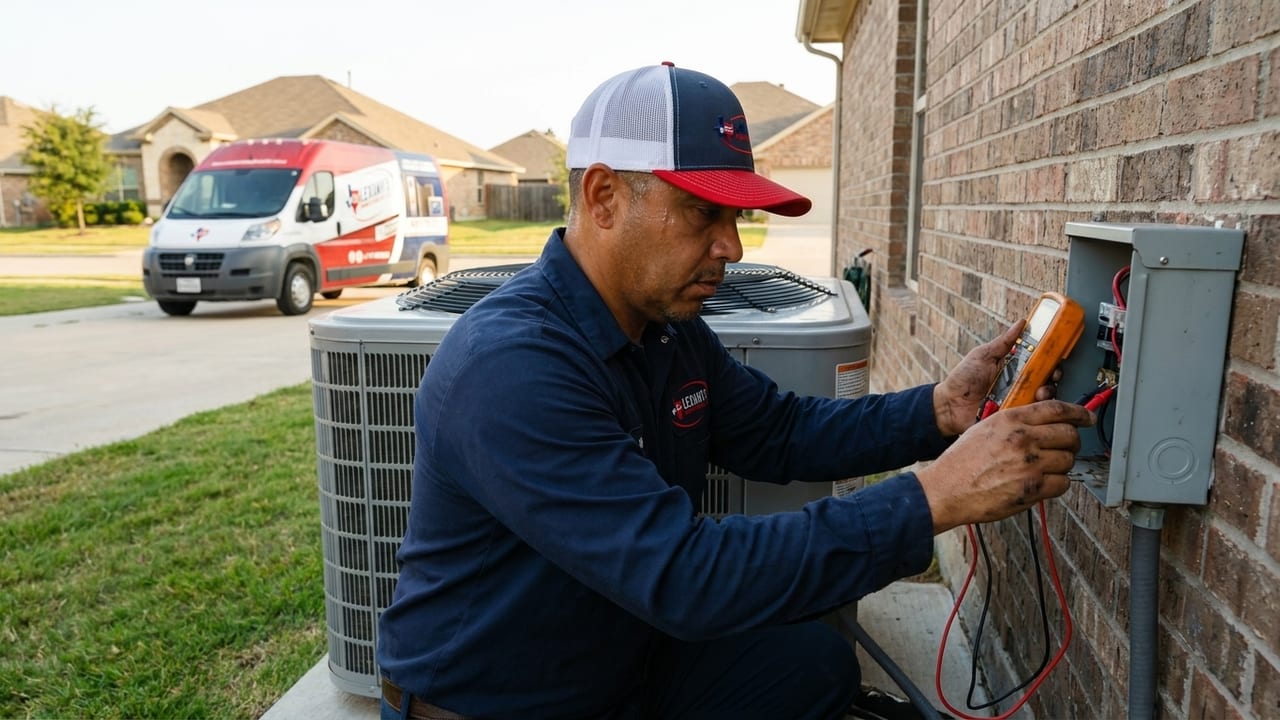
An air conditioner that breezed through May can start falling behind once the Forney afternoons climb past 100°F. That’s because summer heat doesn’t just feel harder on your AC — it genuinely is. When a system is undersized, low on refrigerant, or overdue for service, the hottest part of the day is exactly when the cracks show. Here are seven concrete signs your AC can’t keep up, why each one happens, and what to do about it.
Why Forney summers expose a weak system
Your AC doesn’t make cold — it moves heat. It pulls heat out of your home and dumps it outside through the condenser. The harder the sun beats down and the hotter the outside air, the more heat keeps pouring back in and the harder the system has to work to stay ahead. On a mild day, a tired or undersized AC can fake it. On a 105°F Kaufman County afternoon, the same system simply can’t move heat fast enough — and you feel the difference by 4 p.m. These are the seven signs that the heat has found your system’s weak spot.
The seven signs your AC is falling behind
One of these on a single record-breaking day might be nothing. Several of them, day after day, is your system telling you it’s running out of headroom.
- It can’t reach the setpoint anymore. You set it to 72°F and the thermostat hovers at 76°F or 77°F all afternoon, no matter how long the system runs. That gap between the setting and the actual temperature is the most direct sign the AC can’t remove heat as fast as the house is gaining it — usually from low refrigerant, a dirty coil, or a system undersized for the home.
- It runs nonstop and never shuts off. A healthy AC cycles — it cools the house, satisfies the thermostat, and rests. If yours runs from noon to sundown without ever cutting off, it’s working flat-out just to tread water. Long cycles on the hottest days are normal; constant running that still loses ground is not.
- Upstairs rooms stay warm while downstairs is fine. Heat rises, the upstairs takes the brunt of the roof’s sun load, and ductwork to far rooms often loses capacity along the way. When the downstairs is comfortable but the bedrooms upstairs run several degrees hotter every afternoon, the system — or the duct design — can’t deliver enough cool air where the heat is worst.
- The air indoors feels sticky and humid. A right-sized, healthy AC pulls moisture out of the air as it cools. When the system is struggling or short-cycling, it doesn’t run long enough in the right way to dehumidify, so 74°F starts to feel clammy instead of crisp. If your home feels muggy even when the thermostat says it’s cool, the system isn’t doing the second half of its job.
- Your electric bill jumps in July and August. An AC that’s fighting a dirty coil, low refrigerant, or simply too much heat draws more power for less cooling — and the longer run times pile onto the bill. A summer bill that’s noticeably higher than the same month last year, with no change in how you use the house, is often the first measurable sign the system is straining.
- Ice forms on the refrigerant lines or the coil. It seems backwards in a heat wave, but ice is a classic sign of a struggling system. Restricted airflow from a clogged filter, or low refrigerant from a leak, drops the coil below freezing and condensation turns to ice. The iced coil then blocks airflow entirely, so the house gets warmer. If you see ice, shut the system off and let it thaw fully before running it again — running a frozen coil can wreck the compressor.
- It freezes up, then blows warm, in a daily cycle. This is the previous sign taken one step further. The coil ices over during the hottest hours, the unit stops cooling and blows warm air, then it thaws overnight and seems fine again in the morning — only to repeat the next afternoon. That freeze-then-warm rhythm almost always means low refrigerant or a chronic airflow restriction, and it won’t fix itself.
Before the worst of the heat, swap in a fresh air filter and rinse the outdoor coil with a gentle hose spray (power off first), then clear shrubs and debris back two feet on all sides. A clean filter and a coil that can actually shed heat give a borderline system back some of the headroom it lost.
What to do when your AC can’t keep up
Start with the two free checks above — a fresh filter and a clean, clear outdoor unit fix more “can’t keep up” calls than people expect. If the house still drifts above setpoint every afternoon after that, it’s time for a tech to take a real look. Low refrigerant means there’s a leak that has to be found and repaired, not just topped off. Ice that returns, a daily freeze-then-warm cycle, or a system that simply can’t hit temperature on a normal summer day all point to something a licensed tech needs to diagnose with gauges and the right tools.
And if the verdict is that the system is genuinely undersized or worn out, that’s worth knowing before the next heat wave rather than during it. We’ll measure the load, walk you through your options honestly, and put any estimate in writing — whether the right answer is a repair or a properly sized replacement. Regular seasonal tune-ups are the best defense against capacity quietly slipping in the first place.
If your AC ices up and starts blowing warm air, turning the thermostat colder won’t help — it makes the freeze worse. Switch the system off, let it thaw completely (often a few hours), and call. Running a frozen coil pushes liquid refrigerant back to the compressor, which is one of the most expensive parts to replace.
When the afternoon heat is winning, Gustavo and the team handle most calls around Forney the same day — and you’ll reach a real person at 469-728-7113. We’re residential-only, hold a Texas A/C License #51447, are NATE certified, and we work in English and Spanish across Forney, Mesquite, Terrell, Kaufman, Heartland, Rockwall, Heath, and Kemp.
AC Performance FAQs
Why does my AC keep up in the morning but not in the afternoon?
That’s one of the clearest signs a system is running near its limit. In the cooler morning the AC only has to remove a little heat, so it keeps pace. By mid-afternoon, with the sun on the roof and the outdoor temperature past 100°F, the heat coming into the house can exceed what a struggling or undersized system can pull out. The gap shows up as a house that drifts a few degrees above the setpoint every afternoon and recovers overnight.
Is it normal for my AC to run nonstop on a 105°F day?
On the very hottest afternoons of a Texas summer, longer run times are normal — the system is fighting a big temperature difference. What isn’t normal is running nonstop and still falling behind on the setpoint day after day, or running constantly on a milder day. Steady long cycles that actually hold temperature are fine; constant running that never catches up points to low refrigerant, a dirty coil, or a system that’s undersized.
Can a dirty outdoor unit really make my house warmer?
Yes. The outdoor condenser’s whole job is to dump the heat your AC pulled out of the house into the outside air. When the coil is caked with dust, grass clippings, or cottonwood fluff — or shrubs are crowding it — it can’t shed that heat well, so the system runs longer and cools less. Rinsing the outdoor coil and keeping two feet of clearance around the unit is one of the highest-value things you can do before the worst of the heat.

Owner of Lexany’s Heating & AC. Family-owned in Forney since 2011 — most days he’s the one on the truck doing the work himself. Bilingual (English/Spanish).