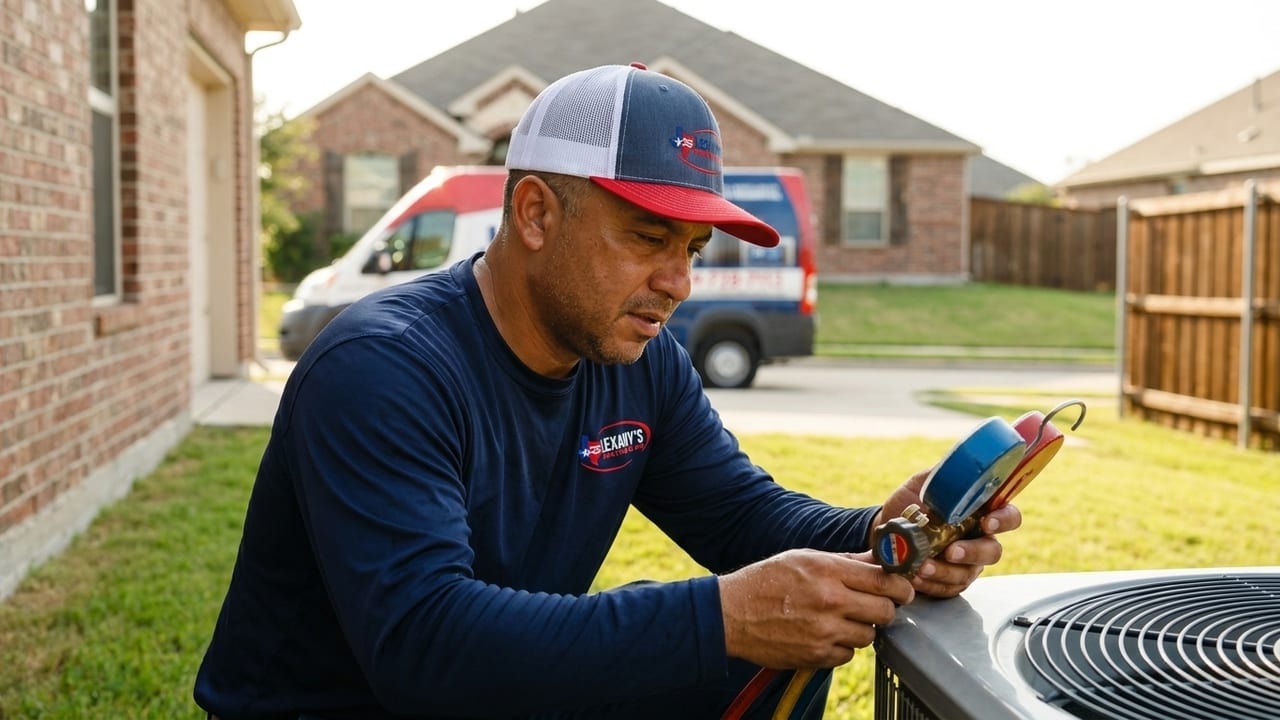
When your HVAC system does something unexpected — makes a noise, stops cooling, starts and stops too fast, or just won’t come on — the first impulse is usually to call someone immediately. Sometimes that’s the right call. But a lot of the time there’s a simple explanation you can check yourself in five minutes before anyone drives out. This guide walks through the most common symptoms, what they usually mean, and the line between “I can handle this” and “I need a tech.”
Four safe checks to do right now
Before anything else, run through this list. These are the most common reasons a system seems broken when it isn’t — and they’re all safe for a homeowner to check without touching any equipment.
- Change or check the air filter. A completely clogged filter can choke airflow enough to make the system freeze up, short-cycle, or blow warm air. If yours looks gray and matted, swap it out before anything else. Most residential filters should be checked monthly and replaced every 1–3 months depending on the type.
- Check the thermostat settings and batteries. Make sure it’s set to “Cool” (not “Fan” or “Heat”), the target temp is below the room temp, and the fan is set to “Auto” — not “On.” If your thermostat runs on batteries, low batteries can cause erratic behavior or a blank screen. Replace them and wait a few minutes to see if the system recovers.
- Check the breaker. Find your electrical panel and look for the breaker labeled for the AC or air handler (sometimes two separate breakers). If it’s tripped — sitting between ON and OFF — reset it firmly to OFF first, then back to ON. If it trips again immediately, stop there and call: something is drawing too much current.
- Clear the area around the outdoor unit. The condenser (the big unit outside) needs airflow to reject heat. If grass, weeds, or debris are pressing against the coil, or something is blocking the top, it works harder and can overheat. Turn the system off at the thermostat first, then clear at least two feet of space around the unit and gently rinse the coil fins from the inside out with a garden hose if they’re visibly dirty.
Roughly half of all “my system isn’t working” calls turn out to be a dirty filter, a tripped breaker, a thermostat set wrong, or a blocked outdoor unit. Takes five minutes to check — and if it fixes the problem, you’ve saved a service call.
No cooling or warm air blowing
This is the most common summer complaint. The system is running — you can hear it and feel air moving — but the air is room temperature or warmer than it should be.
Most likely causes
Low refrigerant charge. Refrigerant is the substance that absorbs heat from your indoor air. If the charge is low because of a slow leak, the system can’t do its job. Symptoms: air that’s not very cold, ice forming on the indoor coil, or a hissing sound near the refrigerant lines. This always requires a licensed tech — it’s not a DIY item, and in Texas handling refrigerant without a license is illegal.
Dirty evaporator or condenser coil. If the indoor coil (evaporator) or outdoor coil (condenser) is layered with dust or debris, heat transfer drops and the system loses its ability to cool effectively. Regular seasonal tune-ups catch this before it becomes a problem.
Thermostat issue. A faulty thermostat may be telling the system to cool less than you think, or may be reading the wrong room temperature. Check the four basics above first.
System won’t turn on at all
The thermostat is set correctly and the room is clearly too hot or too cold — but nothing happens when the system should kick on.
Most likely causes
Tripped breaker. The most common reason. Check the panel as described above. If it resets and holds, you’re done. If it trips again right away, there’s an electrical fault and the system needs to stay off until a tech looks at it.
Thermostat has lost power. If the screen is blank, check for dead batteries (on battery-powered models) or whether the thermostat is wired to a blown fuse in the air handler. Some air handlers have a small 3-amp or 5-amp fuse on the control board that blows to protect the board — it’s worth checking if you’re comfortable opening the cabinet and can identify it visually.
Safety switch tripped. Indoor units have a float switch or safety shutoff that cuts power if the condensate drain line backs up and water starts to overflow. A system that won’t start even with power confirmed may have been shut down by this switch. Clearing the drain line usually restores it.
Short-cycling: starts and stops too fast
A properly running system should run in longer cycles — 15 to 20 minutes or more — and settle the temperature gradually. If your system fires up, runs for a couple of minutes, shuts off, and then starts again quickly, that’s short-cycling.
Most likely causes
Oversized equipment. A system that’s too large for the home cools (or heats) the space so fast that it satisfies the thermostat before it has a chance to properly dehumidify the air. You get technically cool air that still feels muggy. This is a sizing and installation issue — not something that can be fixed by adjusting settings.
Dirty filter or blocked return air. Restricted airflow can cause the system to overheat or freeze, tripping a safety limit that shuts the unit down. Replace the filter, make sure all return-air grilles are open and unobstructed, and see if the cycling normalizes.
Refrigerant issues. Low charge can also cause the low-pressure switch to cut the compressor off early. If the filter check doesn’t resolve the short-cycling, refrigerant is worth having a tech verify.
Strange noises
HVAC systems make some noise — a low hum from the compressor, a whoosh when the fan starts — but certain sounds are a signal to stop and pay attention.
What different sounds usually mean
Banging or clanking: Something is loose or broken inside the air handler or outdoor unit — a loose fan blade, a broken component in the compressor, or debris that got pulled into the unit. Turn the system off and call.
Squealing or screeching: Usually a worn belt (on older systems with belt-drive blowers) or a bearing going bad in the blower motor or condenser fan motor. Catching this early means a relatively simple repair; letting it run can burn out the motor.
Hissing or bubbling: Hissing from near the refrigerant lines often means a refrigerant leak. Bubbling or gurgling from the indoor unit can mean air in the refrigerant lines or a blocked condensate drain.
Clicking at startup (that doesn’t stop): A click when the system starts is normal — that’s the relay. Continuous clicking usually means a failing relay or a problem in the control board.
Loud bang at startup (furnace): A single bang when a gas furnace fires is a sign of delayed ignition — gas building up before it lights. Don’t ignore this. It puts stress on the heat exchanger and can eventually crack it, which is a safety issue.
Smells coming from the vents
The first time you run the heat in fall, a brief dusty or “burning” smell is normal — you’re burning off dust that settled on the heat exchanger over summer. If it persists beyond the first few minutes, or if you smell something other than dust, pay attention.
What different smells usually mean
Musty or mildew smell: Almost always mold or mildew growth in the ductwork, on the evaporator coil, or in the condensate drain pan. Common in humid climates after a stretch of heavy use. A coil cleaning and drain-line treatment usually clears it up.
Burning plastic or electrical smell: Shut the system off. This can mean a motor overheating, a wire insulation burning, or a component failing. Don’t run it until a tech has a look.
Rotten egg / sulfur smell: This is the odorant added to natural gas. If you smell this, don’t run any electrical switches, don’t use a phone near the unit, leave the house, and call your gas utility from outside. Not an HVAC tech call first — this is a gas safety call.
A burning smell, a loud bang you can’t explain, or a breaker that keeps tripping: the right move is always to shut the system off and call rather than run it and hope. A tech visit to diagnose a small problem is a fraction of the price of replacing a component you ran to failure.
Water, ice, or moisture problems
Some moisture around an AC system is normal — the indoor coil pulls humidity out of the air as part of cooling, and that water drains through a condensate line. Problems start when water ends up somewhere it shouldn’t.
Most likely causes
Ice on the indoor coil or refrigerant lines: Ice forming on the evaporator coil or on the copper lines running to it means the coil is getting too cold — usually because of low airflow (dirty filter, blocked registers) or low refrigerant. Shut the system off and let it thaw completely (this can take a few hours) before running it again. Fix the airflow problem first; if the ice returns, refrigerant is the likely cause and needs a tech.
Water pooling near the indoor unit: The condensate drain line has a clog. This is a common and easy fix — the drain line runs from the indoor unit to a drain point, and over time algae and debris block it. Shut the system off to stop the overflow, and have the line cleared. If your home’s ceiling or floor shows water damage from an overflow, that needs to be addressed separately from the HVAC repair.
Moisture around ducts or registers: In a humid Texas summer, cold metal duct surfaces can condense moisture from warm attic or crawlspace air if the insulation on the ductwork is compromised. This looks like “sweating” and can lead to mold over time — worth getting checked if you notice it repeatedly.
Suddenly higher energy bills
If your bill jumps noticeably compared to the same month last year — and the weather hasn’t been unusually extreme — something in the system has gotten less efficient.
Most likely causes
Dirty filter or coil: The harder the system has to work to push air through a dirty filter or transfer heat through a dirty coil, the longer it runs and the more power it uses. This is the most common cause and one of the easiest to fix.
Refrigerant below proper charge: A system running with too little refrigerant runs longer cycles and still doesn’t cool as well. Higher bills alongside weaker cooling often go together.
Duct leaks: If conditioned air is escaping into your attic or crawlspace before it reaches the living areas, the system runs nearly constantly trying to satisfy the thermostat. This is hard to diagnose without a duct test, but it’s a real and surprisingly common cause of high bills in homes with older ductwork.
Equipment age: An older system approaching the end of its service life loses efficiency gradually. If you’re already spending on regular repairs and the bills keep climbing, a replacement conversation may be worth having.
Weak or uneven airflow
Good airflow means every room in the house gets reasonably close to the same temperature within a normal run cycle. If some rooms are comfortable and others are consistently too hot or too cold, or if the air coming from registers feels weak, there’s a distribution problem.
Most likely causes
Dirty filter: Check and change it first — every time.
Blocked or closed registers: Walk through the house and make sure supply registers are open (not blocked by furniture) and that return-air grilles are clear. Closing off registers in rooms you don’t use doesn’t save energy — it actually increases duct pressure and can cause problems upstream.
Blower motor or fan problem: If the filter is clean and registers are open but airflow still seems weak system-wide, the blower motor may be failing or the fan speed may have dropped. This requires a tech to test.
Duct problems: A disconnected duct in the attic, a crushed flexible duct, or significant leaks at connections can all cause one room to get almost no conditioned air while the rest of the house is fine. If the uneven airflow problem is isolated to one or two rooms and has suddenly gotten worse, a duct inspection is a reasonable next step.
Symptom quick-reference
When to call a pro
The four checks at the top of this post are safe and often enough. Beyond that, the line is straightforward: if the problem involves refrigerant, electrical components, gas, a burning smell, or anything that keeps coming back after you’ve done the basic fixes — call. These aren’t areas where a homeowner should improvise, and in Texas, handling refrigerant without an AC license is illegal.
The other clear case: if your system is more than 10–15 years old and showing multiple symptoms at once — running long, not cooling well, costing more — a diagnostic visit is worth having. Sometimes the repair is simple; sometimes the honest answer is that the equipment has run its course and replacing it saves more than continuing to fix it. Either way, you deserve a straight answer before you spend money.
Most of the time when you call Lexany’s you’ll get Gustavo himself — the owner, a NATE-certified tech with TX AC license #51447, who’s been doing this since 2011. He’ll tell you what’s actually wrong, what it will cost, and whether a repair or a replacement makes more sense for your home. Same-day service across Forney and the surrounding area. Call 469-728-7113.
HVAC Troubleshooting FAQs
My AC is blowing air but it isn’t cold — should I add refrigerant myself?
No. Refrigerant isn’t something that gets used up like fuel — if the charge is low, there’s a leak somewhere. Adding refrigerant without finding and fixing the leak is a temporary fix that won’t hold. A licensed tech needs to locate the leak, repair it, and then recharge the system correctly. In Texas, handling refrigerant without a license is also illegal.
The system runs constantly but never fully cools the house. What’s happening?
A few things could cause this: a dirty or blocked air filter choking airflow, refrigerant below the right charge, a refrigerant leak, a dirty outdoor coil, or a system that was never the right size for your home to begin with. On a 100-degree Forney day the system will also just be working harder than usual — but if it’s been running all day and can’t get below 80 indoors, something is wrong and it’s worth a look.
I heard a loud bang when the system kicked on. Is it safe to keep running it?
A single loud bang at startup is often a ‘delayed ignition’ in a gas furnace — unburned gas igniting all at once — or a duct expanding under air pressure. Either way, don’t ignore it. Delayed ignition especially should be looked at promptly; running a furnace with an ignition problem can cause real damage. Shut it off and call.
There’s water pooling around my indoor unit. Do I need to turn it off?
Yes, shut it off until someone can check it. A little condensation is normal, but standing water usually means a clogged condensate drain line — which can overflow and damage your ceiling or flooring if left running. It’s one of the easier fixes a tech makes, but letting it flood is much more expensive.
How quickly can Lexany’s come out?
Gustavo offers same-day service across Forney and the surrounding area. Call 469-728-7113 and you’ll usually talk to someone right away.

Owner of Lexany’s Heating & AC. Family-owned in Forney since 2011 — most days he’s the one on the truck doing the work himself. Bilingual (English/Spanish).