Lennox builds well-regarded residential equipment — efficient, quiet, and built to last when it’s looked after. The key phrase is “when it’s looked after.” A Forney summer is long and hard on any HVAC system, and the small things a homeowner can do between service visits make a real difference in how the system holds up. Here’s what you can own, what to watch for, and what a seasonal tune-up handles that you can’t.
Filters: the one thing you own
Filter changes are the single most impactful maintenance task a homeowner can do, and it’s genuinely easy. A clogged filter restricts airflow across the evaporator coil — the system works harder, runs longer, and the coil can ice over on a hot day. On a Lennox system with a higher-MERV filter (common on their mid-range and upper-tier units), a dirty filter creates more resistance than on a basic 1-inch flat filter, so the change interval matters even more.
- Standard 1-inch filters: change every 30–60 days during the cooling season — sooner if you have pets, construction nearby, or dusty conditions in the area.
- Thicker media filters (4- or 5-inch): these last longer — often 6 to 12 months — but check the manufacturer’s guidance for your specific media depth.
- Check the fit. A filter that lets air bypass the edges (gaps around the frame) does almost nothing. The fit should be snug with no light leaking around the sides when you hold it up.
- Write the install date on the filter frame with a marker. It takes five seconds and you’ll never have to guess how old it is.
If you’re unsure which filter your system takes or what MERV rating is appropriate, the model label inside the air handler will give you the filter size. A reputable home-improvement store or HVAC supplier can point you to a compatible option.
Higher MERV is not always better. A very high-MERV filter (13+) in a system not designed for the extra resistance can restrict airflow enough to cause problems. If your system came with a mid-MERV filter, stay in that range. When in doubt, ask a tech which rating the equipment is designed to handle.
Keeping the outdoor unit clear
The outdoor condenser unit sheds the heat your system pulls out of your home. It does that by moving a large volume of air across the coil fins — and anything that blocks that airflow makes the whole system work harder. In a North Texas yard, the common culprits are cottonwood fluff in spring, grass clippings from a nearby mower, leaves in fall, and landscaping that’s grown too close.
- Maintain clearance around the unit. Two feet of clear space on all sides is a reasonable rule of thumb; check your specific equipment documentation for the manufacturer’s minimum. Trim any shrubs or plants that have crept in.
- Don’t stack things against it. A garden hose, patio furniture, or a stored bag of mulch leaning on the unit restricts airflow and can dent the coil fins.
- Rinse the coil fins from the outside. A gentle spray from a garden hose — top to bottom, not bottom to top — clears surface debris. Don’t use a pressure washer; the fins are thin aluminum and bend easily.
- Keep the pad level. Lennox outdoor units sit on a concrete or composite pad. If the pad has settled and the unit is noticeably tilted, that’s worth mentioning to a tech — most units need to be reasonably level for the compressor oil to circulate correctly.
The condensate drain — easy to overlook
As your system cools and dehumidifies the air, it pulls a significant amount of moisture out of it. That water collects in a drain pan and flows out through a PVC condensate line, typically to the exterior of the house or into a floor drain. The problem is that the line runs through a warm, humid environment — exactly the conditions where algae and mold thrive.
A slow clog in the condensate line usually announces itself in one of two ways: standing water in the drain pan (which can trigger a float switch that shuts the system down as a safety measure) or water dripping from the air handler cabinet. Neither is an emergency if you catch it promptly, but left long enough it becomes a drywall repair.
- Pour a cup of distilled white vinegar into the drain access port (usually a small capped pipe near the air handler) every few months during cooling season. It discourages algae growth without damaging the line.
- Check the drain pan under the air handler periodically, especially during the first hot stretch of the year. It should be dry. Standing water means the drain is slow or blocked.
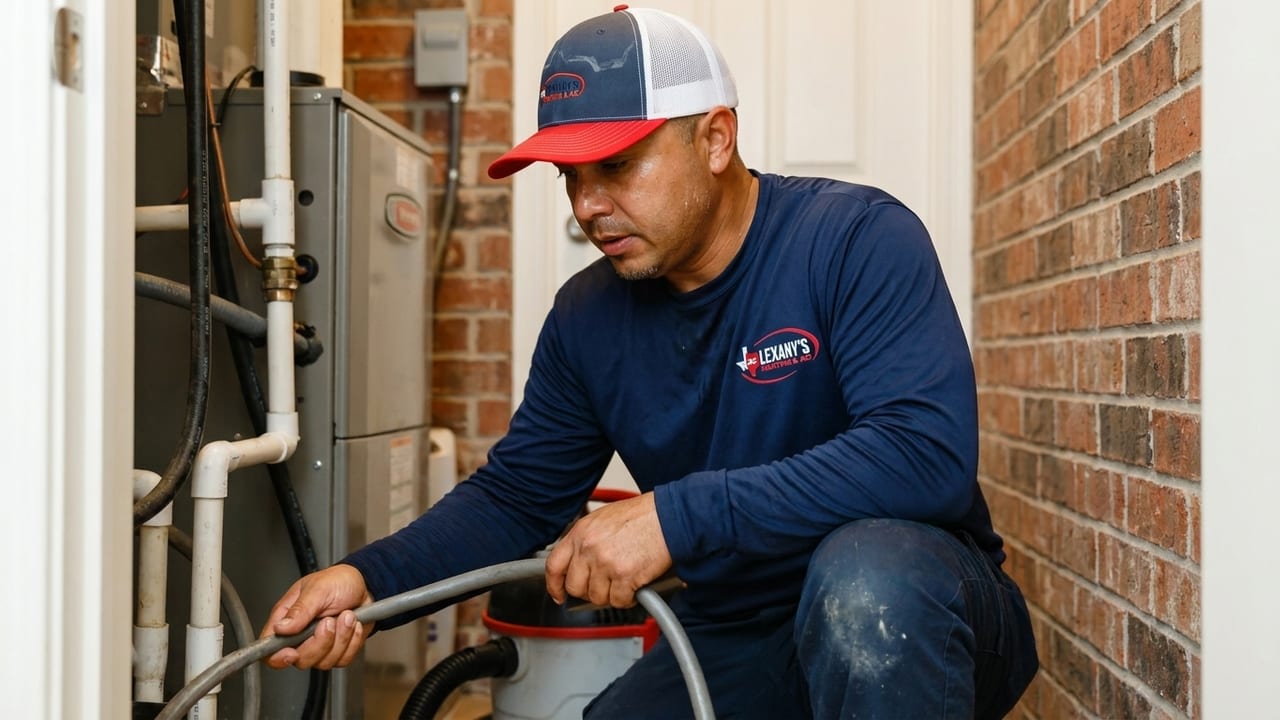
- Clear a slow drain with a wet/dry vacuum on the exterior end of the line, or call a tech — it takes a few minutes to clear properly.
Warning signs your Lennox system needs attention
Most Lennox system failures during a Texas summer aren’t sudden — they’ve been signaling a problem for a while. Catching these early is the difference between a minor repair and a no-cool emergency call in August.
- Warm air from the vents when cooling is on. Could be a refrigerant issue, a dirty coil, a failed capacitor, or a compressor starting to go. Don’t run it and hope — it won’t fix itself.
- Short cycling (the system turns on and off every few minutes). Common causes: a clogged filter, an oversized system, or a refrigerant charge that’s off. Any of these needs a proper diagnosis.
- Ice on the refrigerant lines or coil. Counterintuitive, but ice on a cooling system is a problem — typically a low charge or severely restricted airflow. Shut the system off and call a tech.
- Grinding, banging, or squealing sounds. Normal operation is quiet. New noises from the air handler or outdoor unit — especially mechanical ones — usually mean something physical is wearing or has come loose.
- Noticeably higher electricity bills with no change in usage. A system working harder than it should to maintain temperature shows up on your bill before it shows up as a breakdown.
- Thermostat not responding correctly. If the system doesn’t react when it should, check the thermostat batteries and settings first. If those are fine, the issue may be electrical or a control board — a tech call.
Most calls around Forney and Kaufman County are handled the same day — you usually get Gustavo himself. We service Lennox and all the major residential brands. TX A/C License #51447 · NATE Certified · bilingual EN/ES. Reach us at 469-728-7113.
What a seasonal tune-up actually covers
The homeowner tasks above keep the system breathing and catch obvious problems early. A seasonal tune-up goes deeper — into the parts you can’t safely access yourself.
DIY upkeep vs. what a tech handles
Goodman is our primary line — parts are well-stocked and widely available in North Texas — but we service Lennox, Trane, Carrier, and all the major residential brands. The quality of the service visit matters far more than the badge on the unit.
When to schedule a Lennox tune-up
Spring — before Forney’s cooling season starts in earnest — is the most practical timing for a Lennox system. The coil gets cleaned, the charge gets verified, and the system has a clean bill of health before it has to work hard through a long North Texas summer. Fall is the second good window, especially before the heating season, when the furnace or heat-pump heating mode comes back into rotation.
Gustavo and the team have been doing this since 2011. Most of what goes wrong in a hot summer has a recognizable precursor — a seasonal visit is the chance to find it when it’s a small repair rather than a 100-degree emergency. There’s no contract involved. These are honest seasonal visits — you call when you want one and we come out. Most of the time you’ll talk to Gustavo directly, same day, straight answer, no pressure.
Lennox Maintenance FAQs
How often should a Lennox system get a professional tune-up?
Once a year is the practical baseline for most Forney-area homes — spring before the long cooling season is the most popular timing. If the system runs year-round as a heat pump, a second fall visit before winter is worthwhile. Between visits, changing the filter on schedule is the highest-return thing a homeowner can do.
My Lennox system is still under warranty. Does a tune-up affect that?
In the right direction — most manufacturers require documented annual service to keep the warranty valid. Skipping professional maintenance is what can get a warranty claim denied, not scheduling it. We hold TX A/C License #51447 and are NATE certified, so the work is performed to a recognized standard.
Can I do anything myself, or does everything need a tech?
Filter changes, clearing debris around the outdoor unit, and keeping an eye on the condensate drain line are all realistic homeowner tasks that genuinely matter. Refrigerant checks, coil cleaning with professional coil cleaners, electrical inspections, and anything touching the refrigerant circuit need a licensed tech. The split is roughly: you handle what’s visible and accessible; the tech handles the mechanical and electrical internals.
Is there a contract involved for seasonal tune-ups?
No. These are honest seasonal visits — you call when you want one, we come out, and there’s no ongoing contract required. If you want to set a spring and fall reminder, great. If you just want a one-time visit before summer, that works too.

Owner of Lexany’s Heating & AC. Family-owned in Forney since 2011 — most days he’s the one on the truck doing the work himself. Bilingual (English/Spanish).