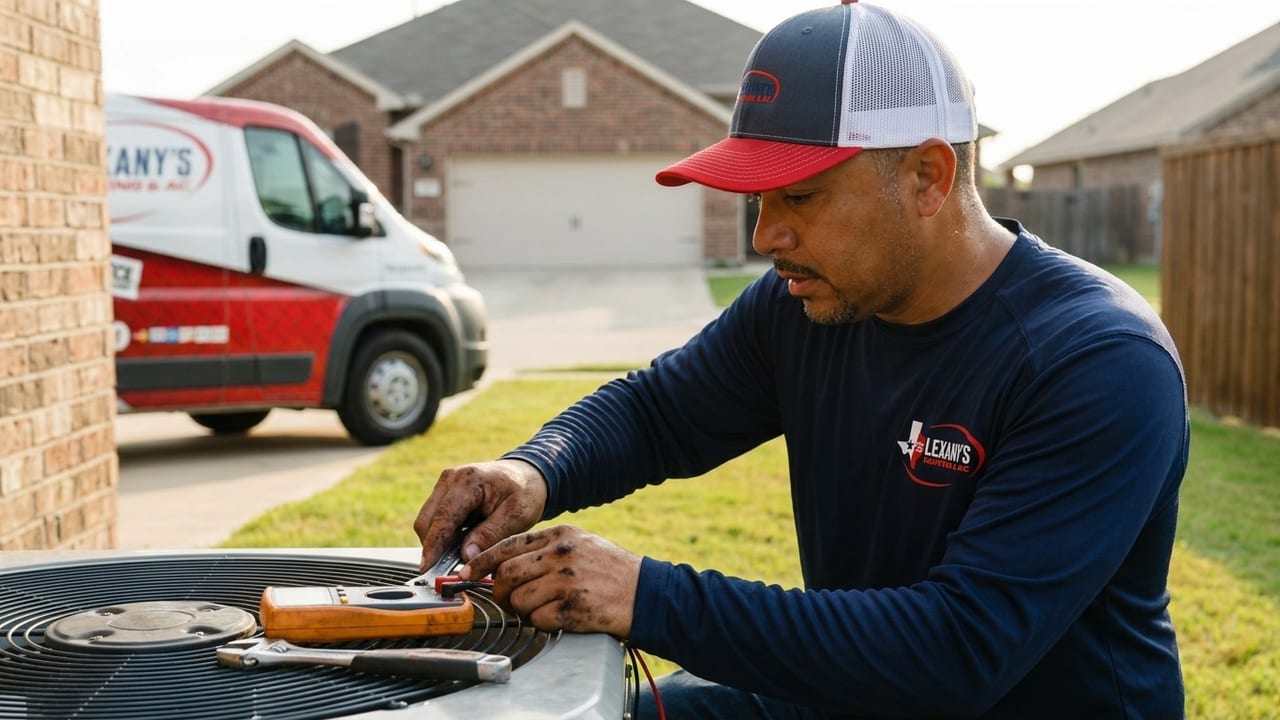
North Texas is one of the better climates in the country for a heat pump. Long, hot summers. Short, mostly mild winters. One system that heats and cools — and earns its keep every single month of the year. Here’s why the fit is so good, and what we actually do when a Forney homeowner calls us for heat-pump work.
Why Forney’s climate suits a heat pump so well
A heat pump moves heat rather than creating it. In summer it pulls heat out of your house and sends it outside — the same job a regular air conditioner does. In winter it reverses direction: it draws warmth out of the outdoor air (there’s usable heat in cold air even when it doesn’t feel like it) and brings it inside.
That reversal is efficient in mild conditions, and Forney winters are mostly mild. We get a handful of hard freezes each year, but most heating-season days sit in a range where a heat pump runs comfortably and efficiently. That beats electric resistance heat and often competes with gas on cost. Meanwhile the same outdoor unit cools your home all summer. One system, year-round work, a single contractor to call.
Heat pump installation and replacement
Installation is the most involved heat pump service we do, and sizing is the part most homeowners never hear about until something goes wrong. A system that’s too large short-cycles, leaves the air damp, and wears out early. A system that’s too small runs constantly and still falls behind on a hot day. Getting it right means calculating your actual home’s load — square footage, insulation, windows, ductwork, which way the house faces — not copying what was there before.
What an installation involves
- A real load calculation on your specific home before any equipment is ordered.
- Matching the outdoor unit and indoor coil — a mismatched coil quietly throws away efficiency you paid for.
- Checking the existing ductwork: leaky or undersized ducts waste even the best equipment, and sometimes that’s the real problem to solve first.
- Setting up backup heat for the rare North Texas freeze — either an electric heat strip or a dual-fuel pairing with a gas furnace, depending on what makes sense for your home.
- A full startup check and walkthrough before Gustavo leaves the job.
When to consider replacement
If your current heat pump or air conditioner is past roughly 12–15 years, running up repair bills, or struggling to keep up with a Texas July, a replacement conversation is worth having. We’ll give you a straight answer on whether repair or replacement makes more sense — and we don’t sell systems we don’t think you need.
Pairing a new outdoor unit with your existing indoor coil can seem like a money-saver, but a mismatched system often loses rated efficiency and can void the warranty. We’ll tell you honestly which way to go.
Heat pump repair
Heat pumps are reliable machines, but they work all four seasons in a climate that swings from the 100s to the mid-20s — more wear than a system that only runs six months a year. When something goes wrong, the symptoms can be easy to misread.
Common signs a heat pump needs attention
- Blowing cool air in heating mode — often a reversing valve, refrigerant, or thermostat issue, not necessarily a failed system.
- Running constantly without reaching the set temperature — can be low refrigerant, a dirty coil, or duct leaks pulling conditioned air into unconditioned space.
- Ice on the outdoor unit (outside of the normal defrost cycle) — usually a refrigerant or airflow problem worth diagnosing before it compounds.
- Unusual noise — grinding, rattling, or a hard start — mechanical wear that’s better caught early.
- Sudden spike in the electric bill — a heat pump working harder than it should often shows up in the bill before anything else.
When Gustavo runs a repair call, the goal is an honest diagnosis first: what’s actually wrong, what it costs to fix it, and whether the repair makes sense given the age and condition of the system. Same-day visits are the norm — call 469-728-7113 and the office will get you on the schedule fast.
Seasonal tune-ups
Because a heat pump runs year-round, it benefits from tune-ups more than a system that only operates half the year. A spring visit prepares the cooling side before the heat arrives; a fall visit checks the heating mode before the first cold snap. You don’t need to do both every year to keep a well-maintained system running well — but skipping tune-ups entirely is where homeowners quietly lose efficiency and shorten equipment life.
What a tune-up covers
- Coil cleaning — a dirty coil is the single biggest drag on heat-pump efficiency and the most common thing we find on deferred systems.
- Refrigerant charge check — off by even a small amount, the system works harder than it should.
- Reversing valve and defrost board check — the parts that are unique to a heat pump and get the most season-change stress.
- Electrical connections, capacitor, and contactors — small parts, but a failed capacitor on a 100° day is an emergency call that a tune-up would have prevented.
- Filter check and a walkthrough of what we found — no surprises, no upsells you didn’t ask for.
We don’t have a formal plan — when you want a tune-up, you call and we schedule it. A spring visit before cooling season and a fall visit before heating season is the rhythm that works well for most Forney homes.
What about the occasional hard freeze?
This is the question most people have when they hear “heat pump in Texas” — what happens when it actually gets cold? The honest answer: a properly set-up heat pump handles the vast majority of our winter days on its own. For the nights that drop into the 20s or lower, we configure a backup. Two options:
- Electric heat strip — built into the air handler; the system switches to it automatically when outdoor temps fall below a set point. All-electric, seamless, and the right call for most homes in our area.
- Dual-fuel — the heat pump pairs with a gas furnace; the furnace takes over when gas is more efficient or the temps drop hard. Worth considering if you already have a furnace and want to keep gas heat as a backup for extreme cold.
We talk through which setup fits your home before any work starts. There’s no universal right answer — it depends on your fuel costs, your existing equipment, and how much you want to spend upfront versus over time.
A family-owned shop in Forney since 2011
Lexany’s Heating & AC has been a residential HVAC contractor in Forney since 2011. Gustavo Garza — the owner and the person doing most of the repairs — is NATE certified, holds TX A/C License #51447, and speaks English and Spanish. If you call, the office answers. If you schedule, Gustavo shows up. That’s the whole shop.
We’re not trying to be the biggest HVAC company in DFW. We’re trying to be the one Forney homeowners call back. If you’re thinking about heat pump service — installation, a repair, or a tune-up before the season turns — give us a call at 469-728-7113 or request an estimate below. We’ll give you a straight answer and an upfront price before any work starts.
Heat Pump FAQs
Can a heat pump really heat a home when it gets cold in North Texas?
Yes. Modern heat pumps stay efficient well into the 30s, and the large majority of our winter days fall well above that. For the handful of nights that drop harder, the system is set up with backup heat — either an electric heat strip or a dual-fuel pairing with a gas furnace — so you stay warm without any gaps.
My heat pump is blowing cool air in heating mode. Do I need a repair or a new system?
Cool air in heating mode usually points to a refrigerant issue, a reversing-valve problem, or a thermostat setting — not necessarily a failed system. Gustavo can diagnose it same day and give you an honest answer on whether a repair makes sense or whether the age and condition of the equipment makes a replacement the smarter call.
How often should I have a heat pump tuned up?
Because a heat pump works all four seasons — cooling in summer, heating in winter — it puts in more hours than a system that only runs half the year. A seasonal tune-up once or twice a year (spring before cooling season, fall before heating season) keeps the coil clean, the refrigerant charge correct, and the efficiency from slipping quietly away.
Do you work on all heat pump brands?
We install and service Goodman as our primary line and handle all the major brands homeowners in the area tend to have — Lennox, Trane, Carrier, American Standard, Daikin, Amana, Mitsubishi, and others. If you’re not sure whether we cover your unit, call and we’ll tell you straight.

Owner of Lexany’s Heating & AC. Family-owned in Forney since 2011 — most days he’s the one on the truck doing the work himself. Bilingual (English/Spanish).